
The success of n-body numerical simulation to predict the motion of planets and stars cannot be denied. At the same time, the erroneous application of these model to intra-galactic objects and galaxies themselves have led to a popular narrative that is full of magic and other non-sense. In this ambitious posting, I have put together the astrophysical data in a different way – one that looks at objects from a more scientific and engineering point of view. This data has been used to show that the various objects in space should be considered as continuum bodies, rather than collections of particles. Classical physical laws and concepts are used to show how and why many of the phenomenon we see and
Video Post – How Friction Creates a Galaxy’s Spirals

The videos presented here represent a culmination of my analysis of spiral galactic structure. The conventional explanations of how spiral work try to shoe-horn the partial differential equations of Navier-Stokes and Maxwell, into the ordinary ones of astro-physicist’s simulations and this leads to gross misrepresentations. It is like an illness in the popular scientific community that is directly related, although less political, to the climate simulators and their ODE simulations of our dynamic, convective atmosphere. “Unicorn” constructs, such as gravity density waves are really how the ODE solutions are tricked into giving realistic results. Shortcuts to PDEs, such as “Ram Pressure”, are elevated to the position of real explanations. There videos take a overview look at how spiral galaxies really
Globular Clusters: The Chaotic Square Dance of the Stars

Globular clusters (GCs) are fascinating cosmic entities that challenge our understanding of chaos and order in the universe. These ancient collections of stars, some over 13 billion years old, exhibit a dynamic system that thrives amidst unpredictability. As we explore the intricate dance of stars within these clusters, we uncover the secrets of their longevity and stability. From the mesmerizing beauty of M5 and M13 to the complex gravitational interactions that govern their behavior, join us on a journey through the chaotic square dance of the stars and discover the mysteries that lie within these stellar marvels.
The Sunflower Galaxy and Dynamic Complexities

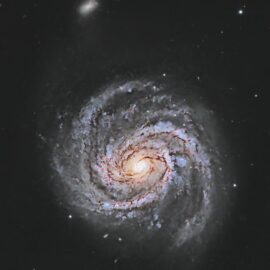
At first glance, Messier 63 (M63 for short or aka “the Sunflower Galaxy”) appears to be a break from the traditional spiral structure of galaxies and represent a new type of galaxy termed a “flocculent” class. It was thought that the stars formed clumpy clouds gathered together as clumps, like strands of wool form clumps of wool – even on the sheep. In chemical engineering, we often use agents that make particles suspended in a fluid clump together to form larger particles ,so that gravity can overcome the suspension and separate the particles from the fluid. I like to thing that the word flocculate (or its sorter “floc”) comes from the word “flock”, as in a flock of sheep,
M100 and the Galactic Circulatory System
Circulation and Jewelry – The Galactic Spiral Structure (Part 5)

In the ultimate post of the series, we finally get to add some of the things that we image in galaxies – emissions, dust, and stars, to the stuff we can’t see – hydrogen and black holes. The stuff we can see brings life to the galaxy and are indeed necessarily for its longevity and new star production.
Gravity is shown to be periodic both in radial and angular directions, just like the spiral, but the various forces at play effect the galactic jewelry in different ways to give us regions of emissions, dust lanes, and star orbits. Explanations are provides as to why the arms can extend for radii way beyond what we do see, why dark matter is unnecessary (just a hydrogen accounting error). The spiral structure even explains why velocity vs radius plots look periodic when even dark matter doesn’t explain it.
Winding Problem Solved – Galactic Spiral Structure (Part 4)

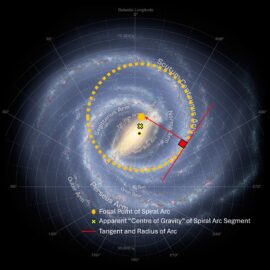
If the galaxy were a disk, gravity would act toward the centre of the galaxy, centrifugal forces in the opposite direction, and viscous drag perpendicular to both. In a galactic spiral structure, this is not the case as components of all three forces act along and perpendicular to the spiral arms. This gives spiral shapes the ability to avoid the arms winding upon each other, and even orbits spots that aren’t at the galactic centre. Force balances on the spiral arms, show how this comes together in this detailed analysis. The post is long, but I think insightful and revealing. Coupled with the thermodynamics of hydrogen – even does away for the need for dark matter.