A Galaxy of Dynamic Gases

The success of n-body numerical simulation to predict the motion of planets and stars cannot be denied.  At the same time, the erroneous application of these model to intra-galactic objects and galaxies themselves have led to a popular narrative that is full of magic and other non-sense.  In this ambitious posting, I have put together the astrophysical data in a different way – one that looks at objects from a more scientific and engineering point of view.  This data has been used to show that the various objects in space should be considered as continuum bodies, rather than collections of particles.    Classical physical laws and concepts are used to show how and why many of the phenomenon we see and image in deep space actually have analogues we see here on earth.  Unlike the popular narrative, this better interpretation enriches the intuitive understanding we have of deep-sky objects – and enables them to be seen as the 3-D, dynamic objects that they truly are.

RASC Victoria Centre: Dave Payne &emdash; Bardard's E (B142/B143) Defined by the Stars

Bardard’s E (B142/B143) Defined by the Stars

Two Views of Barnard’s “E” (B142/B143) in LRGB – Ha
Teleview 127is; AP Mach2 GTO; ASI6200MM, – Baader RGB & 6.5nm NB CMOS opt. filters
Frames: R,G,B: (30,28,24 x 360s, Bin 1, Gain 0); L: (32 x 300, Bin 1, Gain 0); Ha: (35 x 720, Bin 1, Gain 100)
July 13,14,15,18 – 2023, Total integration time = 17.9 hrs

Barnard’s “E” (or “3” if you prefer) lies over a rich starfield in the heart of the Milky Way in the constellation Aquila. Two dark nebula (molecular clouds) create the E shape primarily by dimming and even blotting out, the stars that lie behind it. This happens with many dark nebula as catalogued by Barnard, but in this instance, the shapes of the nebula combined with the rich starfield map outline a typewritten “E” that is a favourite view with binoculars.  The E is not perfect, as if insufficient ink was in the cosmic typewriter when the imprint was struck over the starfield canvas.
Fortunately, the dusty molecular cloud that we do see is much closer (at ~2000 lys) than most of the stars.  It is primarily the opacity of the dust in the molecular cloud and its blotting out of the stars behind it that allows us to see the “E” (or “3” if you prefer).   The darkest areas of the image, forming the “E” represent a combination of the thickest and highest dust concentration of the molecular cloud and appears very 2 dimensional in the image.  
This image is more akin to the view through an eyepiece/telescope or binoculars – it is the blotting out of the stars that defines the molecular cloud.  However, if one looks closely at the image, one can see some reflection in terms of a reddish brown/grey colour is patches is places.   This colour is coming from a combination of the starlight that manages to pass through the cloud, and more importantly strarlight that reflects off the dust either while passing through, or from closer stars reflecting light off the dust on the cloud surface.
 
For full resolution, downloadable versions please visit RASC Victoria’s Zenfolio site or Astrobin.
RASC Victoria Centre: Dave Payne &emdash; Bardard's E (B142/B143) Defined by the Reflected Light

Bardard’s E (B142/B143) Defined by the Reflected Light

In this alternate view, the direct starlight has been dimmed and reflected light exaggerated to get a better view of structure of the molecular cloud itself.

This effect is gain through the use of AI to identify stars, remove them from the image, and limit the amount they are histogram stretched before blending them back into the image.   Before blending the stars back into the image, the reflected light is more aggressively stretched than would be permissible with the stars left in. 

The result presents us with the second image, where the molecular cloud is much more defined by its reflected light, rather than just by its opacity. It is interesting to me that much more can be revealed about dark nebulosity – not just by viewing it through sub- or super-visible frequency instruments, but also through modern processing techniques.
I should also point out, that due to an error in backfocus, I almost passed up this data for processing due to mis-shapened stars in the corners.   Thanks again to AI, such errors can be corrected nicely via brightness deconvolution. 

Additionally, images were taken to determine if any Hydrogen-alpha emissions were give off the molecular cloud and nothing significant was found.

The Success of Astrophysics

The stereotypical view of science is the view of someone in a lab coat collecting a sample of something of interest and taking it into the lab to measure its properties and dissect its components to understand it.  The scientist would hypothesize how the sample is thought to work and what it is made of and test the sample to see if the hypothesis is correct.    More often than not, however, samples are too hard to obtain, too big to fit, too small to measure, and conditions too hard to reproduce in a laboratory.

Outer space is one of those subjects that doesn’t lend itself well to laboratory investigation.   One can’t get up, walk around, smell and touch outer space.  One can’t readily grab or even emulate samples readily under the correct conditions.   As a consequence an entire scientific field has been built up with the goal of remotely sensing outer space to determine its make-up and properties – astrophysics uses primarily the science of electromagnetic waves (light) to determine the composition and character or space.   Cousins of astrophysics that you made have heard of include geophysics that used the science of pressure waves (sound) to explore geological structure or petrophysics that remotely sense nuclear, electromagnetic, and sonic signatures from rock deep underground via wells or holes to determine its composition and properties.  

In astrophotography, we are limited by the fact that we only get static, 2-D information about the universe that is largely transparent and colourless to visible light.  Astrophysicists, however, have been able to employ almost the full spectrum of light to investigate otherwise objects that are invisible to our optical telescopes and cameras.  By using broadband measurements we can often tell the temperature of these objects.   Spectroscopy, via narrowband emission/adsorption can often yield compositional and density information.   Wavelength/frequency shift (doppler effect) and other “tricks” are often used to obtain dynamic (velocity) data and spatial information turning the galaxies and galactic objects into a 4-D dynamic playground that we can begin to understand at a deeper level.

The more I learn about astrophysics, the more I find myself in awe of what we have been able to learn about it through only photon sensing.   The details of this are worth talking about in future postings, but for now I will be focussing the discussion to what we have been able to find out, rather than how we found it out. 

The difficulty with remotely sensed data, however, involves its interpretation into a real (4D) dynamic model that we can relate to physically, explain, test, and use to make predictions.   In this posting, I will compile and present astrophysical data in a different manner than you might be used to in order in order to explain what is going on in our astrophotography using a better model than the popular one we are often taught.

The Players: Stars and 3 Gases

The astrophysical data tells us that almost everything within the visible portion or all galaxies, and debatably within the visible universe are composed of either stellar condensed material (the stars) or one of three gases.  All four bodies of material are mainly composed of hydrogen (with some helium), and it is the form of hydrogen that defines these four material bodies.  Yes, I am leaving out rocky planets, black holes, and special stars for now but these are details we can address later.

Stars are the source of most of all the light (and arguably most of the electromagnetic energy that produces the light) that we see in our images.   Traditionally, it is argued that stars, including our sun are made out of “gaseous” H+ plasma, but the imaged surface features, coupled with stars broadband emissions suggest that they are in a condensed, incompressible, loose array  – better described as a liquid metal like that found on Jupiter and the other gas giants in the solar system.   The distinction between an incompressible plasma and a liquid metal may only be semantic as far as hydrogen is concerned.  (I find Unzicker’s Real Physics convincing in this, although I don’t always agree with what he says). 

Understanding how stars work is certainly an interesting rabbit hole that I have studied and want to write more about in future postings, but for the sake of this posting and understanding of deep space astrophotography, can be reduced to considering them as point sources of electromagnetic radiation (photons) and solar winds (plasma) of ions and electrons.  

Thermodynamically stars are important in that they are the primary source of heat and photons in a galaxy that drives its inner workings, as well as powering up both its own light as well as the emissions and reflections from the gases that make up the rest of our astronomical images.  Chemically, they are important in that they are also factories for heavier elements (metals) and dust – also necessary to explain the overall thermodynamics – the movement of thermal energy – in the universe.

Astrophysics tells us a great deal about the stars, including a lot about their composition and temperature.  But in terms of understanding how outer space works, and how to interpret the physics displayed by our astrophotographic images, we also have to consider the other players involved and how they all interact.  At least for the time being, i want to reduce the stars to simple points of electromagnetic (light) and ionic radiation.   To partially justify this assumption I will point out that all of the large condensed bodies,  including black holes and regular stars, make up only 3% of the mass of the galaxy and because they are condensed matter, make up a minute portion of the total space or volume.

I think it is safe to suggest that we generally know what stars look like.  In our deep space nebular images they look like points of light, whose size and brightness is generally related to their perceived total brightness, which is generally related to their actual brightness and distance from us.   Their perceived colour is related to their surface temperature, which is described via Planck’s law of black body radiation.  Image of stars in more distant galaxies appear as a luminescent fog as they lose their individual resolution.

The other players, making up 97%ish of the galaxy’s mass and occupying almost all of the volume, are composed of 3 gases – defined by their primary form of gaseous hydrogen: ionic (H+ or HII to astrophysicists), neutral monatomic (H atoms or HI), and neutral diatomic molecules (H2).   Within these gases, the hydrogen form is almost pure, such that the regions of transition between one form and another are generally quite sharp.  It is what these gases look like, the physics of their behavior, and how they interact between themselves and the stars that I want to focus on.   I believe this understanding will make us look at our astro-images in a completely different way.  As with the stars, we can look to astrophysics and spectroscopy to gather information about them.

Astrophysicists rarely present their gas data in the form shown in the table below, that is by composition and with sub-regions based on temperature and density.  Instead, the temperature is often used to define the various regions and the form of hydrogen (and density) is a consequence of the temperature.  The difference may seem subtle, but this tabular form describes a galaxy as being made up of three kinds of gas bodies define by their composition ie. a gas body-centric view.  In constrast, the standard temperature-centric categorization is suggestive of a single gas body, whose properties just change based on its temperature.  I believe that using the temperature basis obfuscates the variation in dynamic and static properties manifested by these three species of hydrogen.  The fundamental data, however, is not mine – it is pure astrophysical data – only the colour coding by hydrogen species and ordering is mine.    The ranges and conditions are also pulled from astrophysical data and should be taken as indicative only – in many cases, it is only the order of magnitude that is important.   have used data pertaining to the Milky Way to show give a general sense of the importance of the gas bodies in spatial and material sense.

Astrophysical data compile by AI for Gas Regions of a Galaxy

It is tempting to immediately interpret this table into a working hypothesis / model of how the galaxy, and, by extension, how the whole universe works.   However, i feel we have to go forward a little bit methodically in order to avoid jumping to conclusions in the same way popular academia has already done.   Before we make the same jump, full of different assumptions, lets apply a little bit of bit of ground work, so that we can interpret the data in reference to both our astrophotographic images, and our real world experiences of potential analogues.

A Quick Guide to the Gases and Where to find them

Understanding what is going on in astrophotographic images is all about understanding these gases and stars, their properties, and their interactions.  The astrophysical data that is given in this chart provides the key to understanding the most important and most impactful processes that are going on, at least within galaxies.  Although it is tempting to jump right in and start rhyming off what the table actually means, I thought I would pause to give you a quick introduction to the table – a very high overview.  This is does not count as a first date – all will eventually be revealed, but think of it as a snap introduction to the gases.

By introducing you to the three types of gases that form our images, my desire is for anyone looking at deep sky objects is to think of them not as 2-D objects, but as the 3-D fluid bodies that they truly are – even if only 1 of the gases is actually visible to us.   All three of the bodies interact with each other in ways that I will show are not a foreign as much of the popular astronomy that you read would lead you to believe.

Also note, that I have not described the hydrogen, [SII], and other narrow band emissions that occur when neutral atoms are stimulated by UV light (ie. by the inappropriate HII region name).  I will be getting to this more in a future posting that, but I will hint that it really represents an interface more than a region, and that the emissions are not due to hydrogen ions at all.

  • Ionized Medium

    Ionized Medium

    Ionized medium, both hot (HIM) and warm (WIM) consists largely of protons  (hydrogen nuclei), alpha particles (helium nuclei) and free electrons in an extremely rarefied form.  We generally consider this medium as gaseous plasma (as opposed to the condensed plasma (or liquid metal hydrogen) that makes up stars and “gas giant” planets.

    When dealing with plasma dynamics, we have to deal with both positively charged ions in addition to their free electrons that requires considerations of not only the same forces of nature that apply to neutral matter, but also forces of charge and magnetism.   

    Plasma physics itself, is an enormous field of study that is necessary to understand everything from cosmology to supernovae to solar winds in space to auroras, lightning, geomagnetism, flourescent bulbs and neon lights down here on earth. 

    To progress this story for the time being,  I am going make a simplifying technical assumption that the electrons and positive ions in our gaseous plasma generally move together as a net neutral charge.  This leaves only the interaction with Lorentz forces or magnetic fields as a potential difference to their behavior than neutral media.   In this model this medium (the ions and electrons) move and behave as a single species, and are allowed to recombine again to neutral forms when conditions allow.  That way too, we don’t have to deal with electrical currents in space. 

    Warm ionized medium (WIM) can be thought of as bubbles around stars (below 50,000 Kelvin) that we call stellar winds.  Stellar winds are guided by the magnetic fields associated with the stars themselves and largely WIM regions travel with the stars,  Due to proximity with the stars, WIM are associated with ultraviolet (and visible) light.  The UV radiation from stars is capable of ionizing neutral gases that it encounters to join the media.   However, as the temperature of the WIM drops, hydrogen and helium ions can recapture their electrons to become neutral media again.  WIM can contain a portion of neutral atoms.  Our solar system is contained in the UV, visible light and WIM generated by the sun that, and as the Voyager spacecraft is telling us, meets up with a WIM travelling in a different direction at the solar systems edge.

    Hot Ionized Medium (HIM) originates in the galaxy from the most massive and hottest (“O” and “B”)  of stars, accretion disks of neutron stars and active black holes, and from supernova explosions.   It is generally orders of magnitude higher temperature (1E6 or higher Kelvin) and is also associated with more intense and higher energy photons – including the X-rays that result from slowing down electrons (Bremstrahlung, or braking radiation).  HIM is generally considered 100% ionized. 

    H+ ions and He+2 ions are transparent to visible and UV light so we don’t see them directly, although we can use narrowband imaging to detect [OIII] or other “metallic ion” signals when the ionization radiation is strong enough.  Otherwise, ionized media often only appears as holes in molecular clouds as newly formed stars are being born from the molecular cloud depths.

    The transparency of ionized media, allows us to see through and image the interface between strong UV radiation from stars and molecular clouds.  Here, hydrogen molecules are being disassociated, ionized at heated to join the ionized medium.  At the same time, some of the ionized hydrogen are recapturing their electrons and become visible via Halpha (and other) narrowband visible light emissions.  Such missions are often misnamed as HII regions, but they are better described as the visible interface between UV light associated with ionic media and molecular clouds.

    It is a good thing that the WIM is transparent too, as it allows us to see out from the earth at the Milky Way and galaxies beyond.  Ionized media makes up about 30% of the spiral disk of the Milky Way, but almost all of the galactic halo.  WIM dominates in the disk, while HIM dominates in the halo.

    The ionized media makes up less than 0.05% of the mass of the entire galaxy – a testament to the ultra low density of its particle make-up.  It is the bouyancy of this media that drives it to leave the galactic spiral disk where heavier neutral media concentrate.

  • (Monatomic) Neutral Medium

    (Monatomic) Neutral Medium

    As WIM cools below 8000K, hydrogen ions can capture surrounding electrons and become neutral atoms that we refer to as Warm Neutral Medium (WNM).   Cooling makes the WNM more dense and its domicile of preference is within the spiral disk particularly within the gaps between the spiral arms, making up 60% of the disk volume.   It is still extremely rarefied, however, and makes up 1.5% of the disk’s mass.  

    Hydrogen atoms in their ground state are just as transparent and invisible to our cameras as is the ionized medium.  While some dusts condenses from metals, it is still too rarefied to show up in our images.

    While both the ionized media and neutral media are invisible to our cameras, astrophysically we can tell the media apart.   We can detect the 21cm microwave emissions caused by the spin flip of the electron with a neutral hydrogen atom.  By determine the possible red or blue shift of this emission, we can also tell how fast these atoms are moving toward or away from us. 

    Neutral monatomic hydrogen also exists surrounding molecular clouds and spiral arms in a much cooler state that we call cold neutral medium (or CNM).  This exists at temperatures much below what would be the partician temperature that would favour hydrogen molecule formation.  However, this transition generally requires a heavier (metal) atom to remove the enthalpy of molecular bonding.  Thus, the atoms exist in a “supercooled” state until two atoms and a third party catalyst can be brought together. 

    Cooling below about 1000 Kelvin to 2000K, hydrogen atoms want to form molecules to reduce its energy state.   Unfortunately for hydrogen, this transformation is highly exothermic and hydrogen atoms are ill-equipped on their own to emit the necessary photons to rid it of this heat.  These hydrogen atoms are held in a sort of suspended animation until they can find a third party dust particle or metallic atom to shed the heat to.   This “transition” state, we call Cold Neutral Medium (or CNM)  normally exists at the interface of of WNM and actual molecular hydrogen.  In total, CNM occupies another 6% of the spiral disk volume and represents about 0.8% of the galactic mass – still tiny, but more than the WNM, WIM, and HIM combined.

    One astrophysical point of note, the electron in hydrogen atoms can flip its spin state in the far IR spectrum at 21cm wavelength, allowing for its detection and even its velocity via doppler changes to this wavelength.  Other than that, neutral medium is the second medium type that is essentially invisible to our astrophotography.

  • (Galactic) Molecular Cloud

    (Galactic) Molecular Cloud

    The final medium that we need to consider are the molecular clouds.  Molecular clouds are most confined to the spiral disk, making up 99% of the gas mass within the disk, and 98% of the total gas mass, and 95% of the total mass of an entire spiral galaxy – including the stars and the central black hole.   All this mass is confined to a space representing only 2% of the total galactic volume, and only 3% of the volume of the spiral disk.  When I first pulled these numbers from the astrophysical data, I was floored when discovered this – this has enormous implications when we look at the role of gravity in molecular cloud and spiral galaxy dynamics.  If you are looking for gravitation fields, you should look to where the mass of the galaxy is – and that is in the spiral arms/molecular clouds.

    Unlike monatomic medium, at the prevailing low temperatures H2 isn’t even detectable by spectrometry.  Spin flip emissions disappear via quantum superposition of the molecules’ two electrons.  Instead, astrophysicists have to use the narrowband emissions from “metallic” atoms and molecules as an (imperfect) tracer to estimate the distribution and density of hydrogen molecules.  This dust isn’t a perfect tracer, however, and H2 can in concentrations that don’t correlate with CO or other metallic substances.  H2 can exist outside of the visible spiral where it exerts its mass, but remains invisible – just like the properties of dark matter.

    While molecular clouds as neutral and largely non-polar, as is monatomic medium, it chemical and thermodynamic properties are quite different.  The cold subcritical temperatures allow for ultra low densities of not only hydrogen, but the suspended dust as well.   It is dusts opacity and reflectivity to starlight that we see.  At the same time, dust allows the passage of infrared light to pass in order for thermal energy to be shed – past all the intervening gas bodies to the sub 4 Kelvin of deep space.   It is dust too, that does all the emitting here, relying on collisions with hydrogen molecules and helium atoms to shed their heat.

    Within the dense core, the dust concentration block all visible light from getting through but is so cold that even normally volatile “metallic” components crystallize.   Unfortunately, this also prevents us from witnessing the nucleation phase of new stars – that occurs when hydrogen molecules condense as liquid or supercritical fluid upon the metallic ice or dust.

    Within the spiral disk molecular cloud media is found either as the spiral arms itself, or as “islands” travelling between the arms.

Application to Astrophotography and Understanding Images

Normal processing of our Barnard's "E" iimage show a background dominated by direct starlight. Other than the "E" little molecular cloud structure is revealed.

At left, a standard processing of our image shows a molecular cloud in front of a rich starfield.  It is almost 2-D in appearance, with a layer of cloud defined by its opacity to the stars behind it.

This view might lead you to accept that the laws of space – defined by gravity, inertia, and electronmagnetic radiation alone – are all that is needed to describe what is going on.

According to the popular astronomical narrative, the “E” is just the gravity collapsing core of GMC, where the dust density and its opacity is sufficiently high to blot out the stars behind it.

Numerical simulation tells us, that the shape of the E is naturally and solely the result of the shape of cloud before it collapsed or in scientific terms its “initial  conditions”   Once you know these initial conditions, you can predict what the cloud will look like in the future. 

Advance image processing allows us to selectively dim the direct starlight, while exaggerating the light that bounces off the cloud itself – in other words reflected light.  A lot more details of the cloud are revealed, it now appears to have a complex structure – and looks more like the three diimensional clouds that we see in the sky.

There is a key difference that one has to keep in mind.  The degree of opacity is determined by the thickness and dust concentration through the cloud.  With reflections, one is looking at the surface of the gas body, and the form of the body is dependent on the location of the light source and how diffuse the light is.  Shadows and angles give definition to the boundary of the gas body with other, transparent and non-reflective gas bodies.

The same image can be processed to reduce the direct brightness of the stars, while exaggerating the light that is reflected off the molecular cloud dust. This reveals more of the gas cloud structure.

Being able to visual a molecular cloud in 3-D from a 2-D takes practice.   You have to integrate the information the information you receive from both opacity (the fading and blocking out light from behind) and reflections of diffuse or more direct star light off of the gas body surface.  Fortunately, perhaps the best practice we can get is by the looking at gas bodies that contain suspended “dust” particles here on earth – ie. clouds and smoke.   

By watching how fluid bodies move, for example – how clouds move and are shaped by the wind and thermodynamics, one can get a sense of the dynamics at play in molecular clouds too even though our deep sky images only yield a time static view.  We know that clouds in the sky are bodies of gas, of a different composition than the transparent “air”  that clouds are suspended in.  In a cloud, the physical and optical properties and conditions it exists differ from the air above and below.  Many of these properties are different due to the presence of tiny water droplets – analogous to the tiny dust grains suspended in a molecular cloud.  But there are other forces at work too – responsible for the droplet of water in the first place, but also responsible for its apparent cohesiveness and sharp, albeit fluffy, contrast to what surrounds it.   

The standard astronomical narrative would suggest that the physics that govern clouds (thermodynamics and fluid mechanics) are completely different for those that govern molecular clouds (gravitational  instabilities).   Any spirals you might see, such as turbulence, accretion disk, or even at a larger scale are not due to fluid, thermodynamics, or friction – but are due to gravitation density waves that galactic spiral arms not even material – despite our astrophysical data table.   It is my assertion that in both terrestrial and galactic molecular clouds – the underlying physics are the same.   The relative importance of the forces and the overall geometry may be different but the two kinds are mostly analogous.   

The astrophysical data, coupled with what we can see through our eyes and astrophotographs present a massive (existential?) problem to the standard astronomical narrative.   Rather than a universe limited to gravity, momentum, and light alone, perhaps we have to incorporate the laws of thermodynamics, fluid mechanics, magneto hydrodynamics, chemistry and even quantum mechanics.  Perhaps there is more to the gases than simply molecules that bounce off one another with perfect elasticity, perhaps there is friction, electromagnetism, turbulence and energy dissipation too.  Maybe we cannot tell what the universe will look like in the future by simply setting the initial conditions (big bang) and approximating the solution to ordinary different equations as if the universe ran like a watch.  Perhaps we have to use chaos theory, apply boundary conditions in space and time, and solve much more messy partial differential equations instead.

Overall, I believe a shake-up at the very least needs to be applied to the standard narrative.   We need to take a step back away from the band-aids that are used – including gravitational cloud collapse, gravitational density waves, and dark whatever you like to cover for the narrative’s inadequacies.   Fortunately, earthbound science has provided us with a method with which we can determine how everything from galaxies to nebula out to be treated.

A Question of Scale

The popular line that we all hear is that gases in space are so rarefied  – the molecules are so far apart – that the only forces of consequence are inertial and gravity – the only forces that can exist for neutral particles at such a distance.   The narrative suggests that collisions between atoms happens so infrequently that they are unimportant.  Since they are unimportant, we can simplify their as an “ideal” gas.  After all, as far as pressure is concerned – many gases even at standard conditions behave pretty close to this simplified and idealized manner.

We have to admit, that our astrophysical data show that our deep sky nebulae are in fact extremely diffuse or rarefied compared even to the strongest vacuum that we can create in a laboratory and use to measure properties.  But this cannot be used as justification to ignore collisions or oversimplify gas bodies as behaving ideally.  The problem is that this standard argument is based on an assumption of equivalent volume, surface, and length scale.    What we really should do, to understand the physics better, is to consider how rarefied the gas is, and how frequently particles collide with reference to the vast spatial dimensions of the object we are interested in.

This scale problem harkens back to the 1800s, when the theory of atoms was being developed.  The initial incentive to describe matter as “indivisible particles” came out of the realization that the chemical reactions allways seemed to involve whole number ratios of volumes of gases.   But this flied in the face of Newtonian and classical mechanics, that wonderfully described materials as continuums, that is, it seems one could always divide a substance in half, and the character and properties of that substance remained the same.   How could material be a continuum and made of discrete particles at the same time.   As it turns out, it all depended on how close (or length scale) you chose to look.   For example, if one looked at tiny pollen grains suspended in a fluid, one could see that the pollen grain would change direction due to individual hits – interpreted as tiny particles that made up the fluid (Brownian motion).  In other words, it turns out that how one needs to interpret the physics depended on how far individual particles in a fluid could travel before colliding.   If one were interested in the movement of individual particles or atoms, one had to look at the scale of individual atomic collisions.   If one were interested in the dynamics of the whole body, classical mechanics was the way to go that utilizes the emergent properties and behaviors associated with first statistical and ultimately continuum mechanics involving large numbers of collisions.  

Eventually, the question of scale was formalized  into the dimensionless Kn or “Knudsen Number”,  named after the Danish physicist Martin Knudsen (1871-1949).  Kn is simply the ratio of the mean free path, or distance that a particle would travel before hitting another particle compared to the length scale of the body or problem we are trying to understand.  In the figure at right, the length scale is essencially the diameter of the circle that contains the particle(s).

An example of a large Knudsen number is the movement of stars (leftmost circle in figure).   Stars rarely collide, so we don’t we can track their movement individually and this forms the basis of n-body simulation astronomical simulations.  Physics is nice and simple – inertial forces and forces at a distance (coulombic and gravity) only needs to be considered. 

Kn number definition for scale, Credit https://ppt-online.org/372448

When the scale of the problem becomes comparable to the mean free path, however, the collision frequency and character become important.  At a Kn around 1, a particle has about a 50/50 chance of colliding with another as it travels from one side to another.  The ability to describe such a system requires that we characterize the nature of the collisions.  This is the scale of Brownian motion and statistical mechanics are needed.   For example, this is the scale where thermodynamics become important to the system.  The thermodynamic properties (heat capacities, equations of state, diffusivity and dispersion) need to be considered.

Finally, when particles will collide with other particles many times across the scale, then the characteristics of the particles and their collisions can be thought of as a continuum with associated emergent properties.  This brings us to the world we mostly live in, where the scale is so big that we don’t have to consider the movement of individual particles to understand how something works.   Indeed, much of the physics and dynamics can only be studied and understood at this scale.

To understand and know how to treat the gases that comprise the gas bodies we image in space, we need to determine what Kn, or what scale, we should use.  The standard narrative suggests that the gas is too rarefied to be considered a continuum, but is this really true?

Van der Waals and the Real Nature of Gas Bodies

The simplest way to move between scales is to assume that gas bodies behave ideally.  The basis for this assumption is that all collisions are perfectly elastic and non-dissipative (i.e. conservation of kinetic energy)*.   In this world, the sole role of collisions is to change the direction of particles.   While the ideal gas assumption is fine for quickly calculating pressure by simplifying the math, the actual, physical belief in this assumption is arguably the most devastating assumption to science and understanding one can make.  To accept it as true, is to deny the world around us, including electromagnetism, solids and liquids, chemistry, friction and turbulence, quantum mechanics, etc. etc. – denies everything substantive but mass, perhaps light and denies all forces but momentum and Newtonian gravity.   Adherence to the ideal gas assumption is why, so much cosmological effort is spent creating wild theories to explain stuff that we see every day in the real world.

The assumption of ideal behavior has a huge amount of appeal to lazy astrophysicists.  Gas behavior is independent on composition since they all act the same.   Everything can be categorized as hydrogen, helium, or “metal” and these only differ in particle mass.   Metal can only be gaseous or dust but we don’t need to know why.  Energy is only transferred via electromagnetic radiation.   The only potential energy is gravity, and the only manifestation of it is light and momentum.  There are many simplifying reasons why this oversimplification has appeal, but the primary one is likely the fact that these lazy astrophysicists can still use their n-body simulators.   (Note that this is the same reason why climate “scientists” make the same assumption – no need to deal with convection, cloud formation, water evaporation, and other ugliness – just accept that the science is settled).

But the ideal gas behavior assumptions paints a very sterile world.   A world where exotic phenomena, such as gravity density waves, gravitational cloud collapse and dark stuff needs to be replace what real world dynamics already show.  

The problem with the ideal view, is that most real gases don’t behave as ideal gases.  Even when pressures are not too far off, emergent properties of continuum mechanics such as phase behavior, internal friction, convection and even turbulence itself cannot be explained.  So if want to know if molecular clouds and other celestial gas bodies obey the same physical laws as we use to explain clouds in the sky, then somehow we have to bridge the gap between particles that only collide perfectly elastically and rarely at that, to the world of real world continuum mechanics and non-ideal gas behaviors that we see every day.

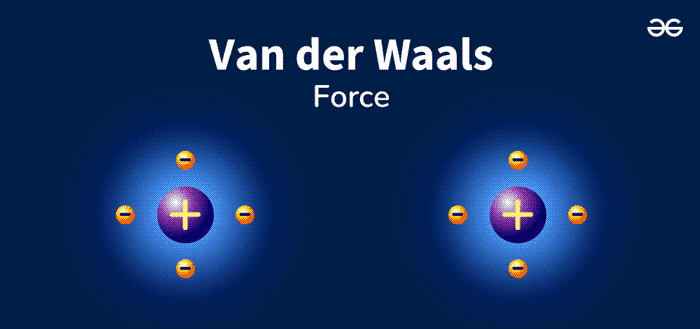
In 1910 (five years after Einstein’s annus mirabilis) a Dutch physicist by the name of Johannes van der Waals was awarded the Nobel prize for his work on molecular physics that bridged the gap.  He was able to show that the non-ideal behavior of gases depended primarily (although not exclusively) to what happens when they collide.  Polar molecules could be though of as magnets that stuck together – either temporarily (or more permanently in the case of liquids and solids), when they collided.   Even non-polar molecules like hydrogen or nitrogen, when they could induce polarity or change the electric charge distribution in one another, at least temporarily making them stick together.

When atoms/molecules collide, induced charge distribution can make them sticky - and the collision becomes inelastic.

His work, not only helps us calculate the Knudsen number by providing the size of atoms and molecules, but even more importantly, characterized the nature of collisions to demonstrate how they manifested themselves in the macro-properties and behaviors of continuum bodies.    In other words, while Knudsen showed how to deal with collisions depending on scale (the importance of collisions), Van der Waals showed how electromagnetic stickiness (the nature of those collisions) leads to the continuum scale properties of matter itself – particularly in the properties of gases.  Space may not be the same as down here, but at least it rhymes and this enables us to use patterns and analogues to figure out how it works.

To a scientist, Van der Waals forces or “molecular stickness” was able to describe thermodynamic concepts such as phase behavior, internal Newtonian friction or dynamic viscosity, non-ideal gas behavior, and many aspects of heat and mass transfer, fluid flow, phase behavior, magneto-hydrodynamics, etc.  These are typically properties that we can measure in a laboratory (or at least estimate via interpolation and extrapolation) and use to explain the behavior of celestial gases to form both stars and galaxies.    To ignore van der Waals and treat collisions as unimportant and gases as idealized collisions is to ignore real reality and create a false one.

* the true definition of an ideal gas represents atoms and molecules as point masses with no volume.  This means that particles cannot collide because they have no volume.   Attribution of volume means that the particles can collide, but assuming perfect elasticity allows for no heat exchange – only the direction of particles changes.   Some fake physicists allow for volume, so that they can model diffusion and dispersion,  which they then push out as a form of viscosity, which real physicists know is not true.  (Ideal gases are inviscid).   Ironically, Van der Waals showed that attributing volume to ideal gases makes them violate ideal gas law because their volume actually takes up some of the space that they would otherwise be free to move in.

From Barnard to Knudsen

The mean free path of a particle is essentially the typical distance a particle can travel before it collides with another one.   Naturally, the more particles in a given volume, the shorter the distance a given particle can travel.   In addition, the bigger the particles happen to be, the more likely a collision will occur.   Below you will find a table that list the approximate mean free path that a hydrogen particle (ion, atom, or molecule) can travel before colliding with another using particle densities taken from our astrophysical table, and particle sizes taken from Van der Waals.

Upon determine the mean free path of hydrogen particles, I was at first struck my their magnitudes of the mean free paths.   It is admittedly hard to imagine that a single tiny atom in, say, the cold neutral medium can travel multiple astronomical units before colliding with another.  Maybe, I thought, am I wrong?  But I was then buoyed by the realization that we were talking about very fast moving particles, and that there would be lots of collisions occurring frequently even in an astronomically puny volume represented by a cubic kilometer.  But I still had to check how this compared to our Knudsen scale with any of the gaseous bodies that were imaged in my “Barnard’s “E”.

As an acid test, I decided to pick the smallest gas body that I could possible be image – a body that would only occupy half a single pixel in diameter given my imaging rig.  At the distance of Barnard’s E of 2,000 lys, this would represent a gas body that is 0.01 lys in diameter.   In the second last column of the table, I have listed the characteristic Knudsen number for the various gas types / compositions.   (One special note, for ionic media, I assumed collisions would be coulombic in nature, and thus the particles would present themselves as larger targets for mean free path considerations.)

For all but one of the gas regions of 0.01 light years in size, the Knudsen number is much less than 1, meaning that we are generally safe to apply continuum mechanics in physics, for pretty much anything we might image with our cameras.   But it goes further than that.   It also means that we should treat the bodies as continuous media when we try to understand what they are, what they are doing, and why they are doing it.  The fundamental assumption that the molecules are so far apart that intermolecular forces can be ignored or grossly simplified is not true.   

A second calculation was done on gas cloud that might fill my camera frame.   Of course, this would represent a gas body that filled my camera frame.   Larger bodies mean that the larger characteristic dimension leads to an even smaller Knudsen number where the nature of molecular collisions and non-ideal behavior is important too.   It is worth saying that these assessments don’t just apply to the molecular clouds that we can see, but also to the ionized and neutral media that we cannot.   For the most part (with hot ionized medium being the only exception), we can treat gas body interactions according to continuum laws as well.  

The continuum conclusion is the antithesis of the standard astronomical position used to justify a “particle” model used by n-body simulations.  Intermolecular forces are indeed important and Navier Stokes partial differential equations govern the movement of the gas bodies, rather than Keplerian orbits or even statistical mechanics.  The gases are governed by the laws of thermodynamics and fluid mechanics rather than random walks.  Turbulence is real and its effect require incorporation into our models.   We need to know the continuum properties of our gases in order to understand what is going on in our images.   

Even ionized media, when looked at a large enough scale should be though of as a continuum.   Concepts in magneto-hydrodynamics – an extension of fluid mechanics that combine Navier Stokes with Maxwell’s equations are appropriate.   Fluid mechanical concepts such as the Reynolds number (ratio of inertial to viscous/friction forces) can be extended to include the Magnetic Reynolds number (ratio or magnetic to friction forces) in describing ionic flows. 

As the table suggest, we do have to make an exception, especially at intra-galactic scales, for low density, often hot ionized plasma.  This likely includes supernova remnants and Wolf-Rayet stars.  For galaxy images, their distance means anything we capture, with the possible exceptions of stars and plasma under magnetic influence, the scale of gas bodies can all be treated as continuum – even the hot ionic media.

A word of caution about intergalactic medium, however, that is the hot ionic medium that exists between galaxies, that I deliberately left off of the astrophysical table.   This is the world of cosmology where there is considerable debate about what is giving structure to the cosmic web.  I will leave this discussion for some future postings, but I will refer you a link to one of my favourite youtube resources on the matter.

The good news is that with only a few exceptions, we can relate the gas bodies in space as similar to the gas bodies on earth.  The bad news is that we must abandon the n-body, ordinary differential equations (in time only) that is so successful for Keplerian discrete particle motion.  Instead we must embrace the messier, partial differential equations (in time and space) that describe continuum.  (Is that why we call them Messier numbers?).   This world of continuum fields and matter are computationally much more difficult, but much more interesting.

I know I have been very harsh on astronomers and the standard astronomical narrative during this posting, but I simply don’t enjoy fakery and being led down a garden path.   From reading literature, I understand that very few modern astrophysicists and astronomer actually believe it either.  Perhaps it says something about academia today that professional’s are afraid to state it out loud.

In any event, if you are an astrophotographer, please do me a favour and have a relook at your deep space images again.   I would like you to image the three types of gas bodies as 3D objects and focus on dusty diffuse reflections or even Ha emissions as interface surfaces between molecular clouds and surrounding ionic or monatomic neutral 3D gas bodies.  I am hoping that, with this frame of mind, the 3-D richness and even the dynamic behavior of the subject matter enriches your view.

The Curtain Pulled Back

Using Astrophysical Data, Kn, Van der Waals, and extrapolated lab measurements, we can estimate gas body properties including pressure and viscosity)

For those who have an undestanding of chemical engineering, thermodynamics, and fluid mechanics, the interpretation of this table reveals a lot more about astronomy that any number of n-body simulation ever could.  It immediately dispels a lot of the nonsense that we have been told.  Before I tell you what the table infers to me, I just want to let you know that the data is not mine – it was created by astrophysicists, with pressure and viscosities based on standard interpolations and extrapolations founded on experimental work.   Only the compilation of the data do I take responsibility for.

Here is a list of the few physical things that I take away from this table:

  1. The galaxies are dynamic systems, far from equilibrium.  They should be considered heat engines with thermodynamics playing at least an equal role as gravity at driving the form of the gas bodies
  2. Temperature and thermodynamics are the main driver of decreased media density towards the dense, pre-stellar core of molecular clouds.  Gravity does eventually come to help the situation, but it cannot thermodynamically be the main driver as “Jeans’ instability” tells us.   It is likely that turbulent eddies also play a big role in creating the densities necessary for star nucleation. 
  3. The galactic spiral arms are very material and form the predominant gravity field in the galaxy.  They are not formed by gravity waves from the stars since stars only form a small percentage of a galaxy’s total mass.
  4. There is no winding problem associated with a galaxy’s arms, and therefore not winding problem to solve.  Spiral arms maintain their integrity through viscous forces (viscosity friction is a cohesive force) and gravity.
  5. Gas bodies should be thought of as interacting and three dimensional.  Viscous effects play are role in the interface, becoming laminar and stable in some instances, and turbulent and erosional in others.
  6. ….

For those not as familiar with detailed fluid mechanics, you can take heart that applying analogues that you encounter here on earth to what we see in space is often very valid.

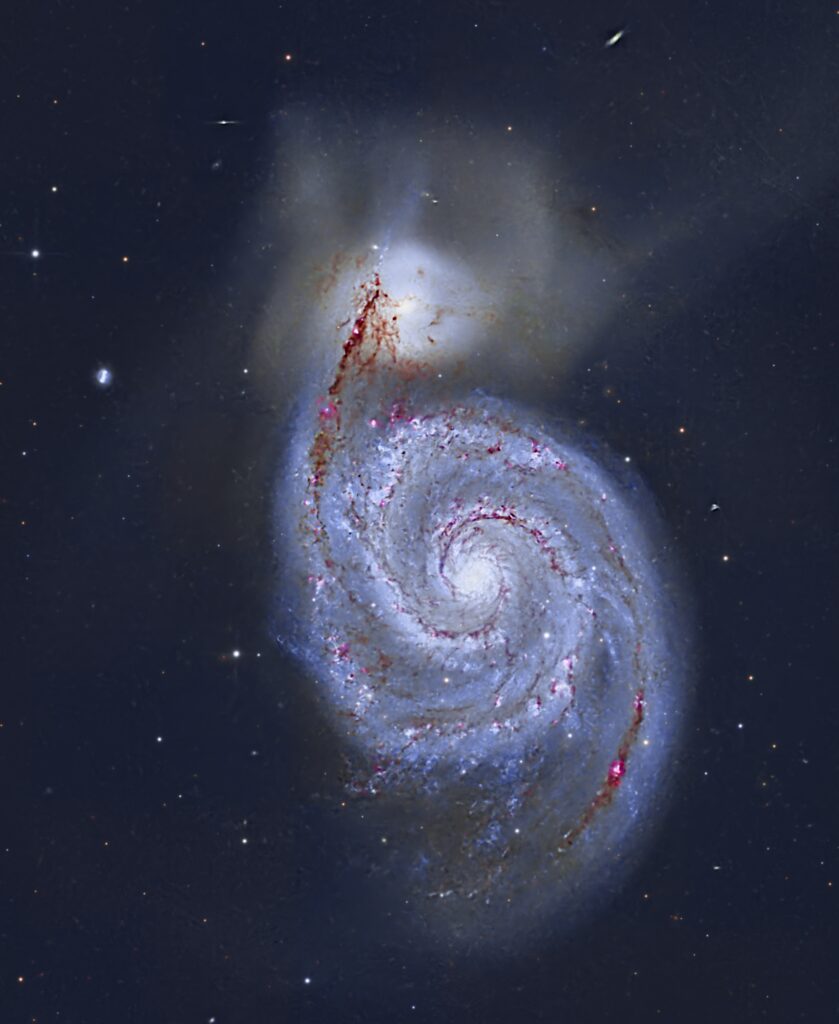
A hurricane looks like a galaxy.  Neither suffer from the winding problem, both are made out of the same sort of atoms, and the physical laws that govern both are the same.   The reason that a molecular cloud looks and behaves the same as an atmospheric cloud is because fundamentally they are both clouds.  Winds in space occur due the viscosity of the media – just as winds in space occur here due the viscosity of the air.

Above all, don’t let some scientist’s desire to cling to their n-body simulators tell you that these models know anything about what is really going on.  Simulations are not experiments, and their results are neither data, nor proofs.

 (Images credit NASA

Credit: NASA
A Galaxy of Dynamic Gases
Share the Post:

Please contact me with your suggestions, requests, and comments

Other Images and Topics:

Winding Problem Solved – Galactic Spiral Structure (Part 4)

If the galaxy were a disk, gravity would act toward the centre of the galaxy, centrifugal forces in the opposite direction, and viscous drag perpendicular to both. In a galactic spiral structure, this is not the case as components of all three forces act along and perpendicular to the spiral arms. This gives spiral shapes the ability to avoid the arms winding upon each other, and even orbits spots that aren’t at the galactic centre. Force balances on the spiral arms, show how this comes together in this detailed analysis. The post is long, but I think insightful and revealing. Coupled with the thermodynamics of hydrogen – even does away for the need for dark matter.

Read More

M100 and the Galactic Circulatory System

In this blog, we use an Image of M100 to begin a description of how hydrogen (and other components) circulate and distribute around a spiral galaxy. This builds upon and takes another perspective on the series of posts describing the spiral galactic structure described on this website.

Read More

Star Nucleation Amped Up by Tidal Effects

Spiral galaxies can vary widely in the amount of stars they are generating. It is asserted that star nucleation, via the imposition of high pressure over small volumes of molecular cloud, is the rate determining step. Turbulence of molecular clouds in galaxies is greatly increased when the chaotic, but stable, spiral galactic structure is disturbed by tidal effects of nearby galaxies. In this posting, the three main galaxies of the Leo triplet are used to illustrate and link the chain of events from tidal influence to rapid star production in the galaxies we image.

Read More