
The Rotten Fish Heat Engine – LDN1251 (Cepheus) in LRGB
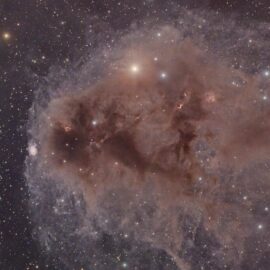
The Rotten Fish Heat Engine – LDN1251 (Cepheus) in LRGB
The Rotten Fish Nebula shows a piece of molecular cloud that has been torn from a spiral arm and eroded by ISM wind and turbulence. While we can’t see molecular hydrogen, we can see the light blocking and reflecting dust it carries with it.
Dust plays an important role in keeping the galaxy cool, particularly is dust nodules, such as this. Cold shrinks the gases, keeps the molecular clouds viscous, and provides the very cold temperatures necessary for star formation. It is the galaxies cooling system. A simple, home experiment is suggested that can help bring the role of cloud collapse and even star nucleation to real life.

Winding Problem Solved – Galactic Spiral Structure (Part 4)

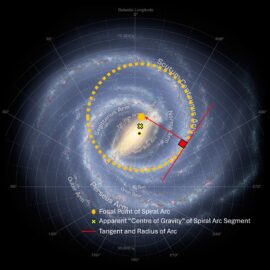
Winding Problem Solved – Galactic Spiral Structure (Part 4)

If the galaxy were a disk, gravity would act toward the centre of the galaxy, centrifugal forces in the opposite direction, and viscous drag perpendicular to both. In a galactic spiral structure, this is not the case as components of all three forces act along and perpendicular to the spiral arms. This gives spiral shapes the ability to avoid the arms winding upon each other, and even orbits spots that aren’t at the galactic centre. Force balances on the spiral arms, show how this comes together in this detailed analysis. The post is long, but I think insightful and revealing. Coupled with the thermodynamics of hydrogen – even does away for the need for dark matter.