
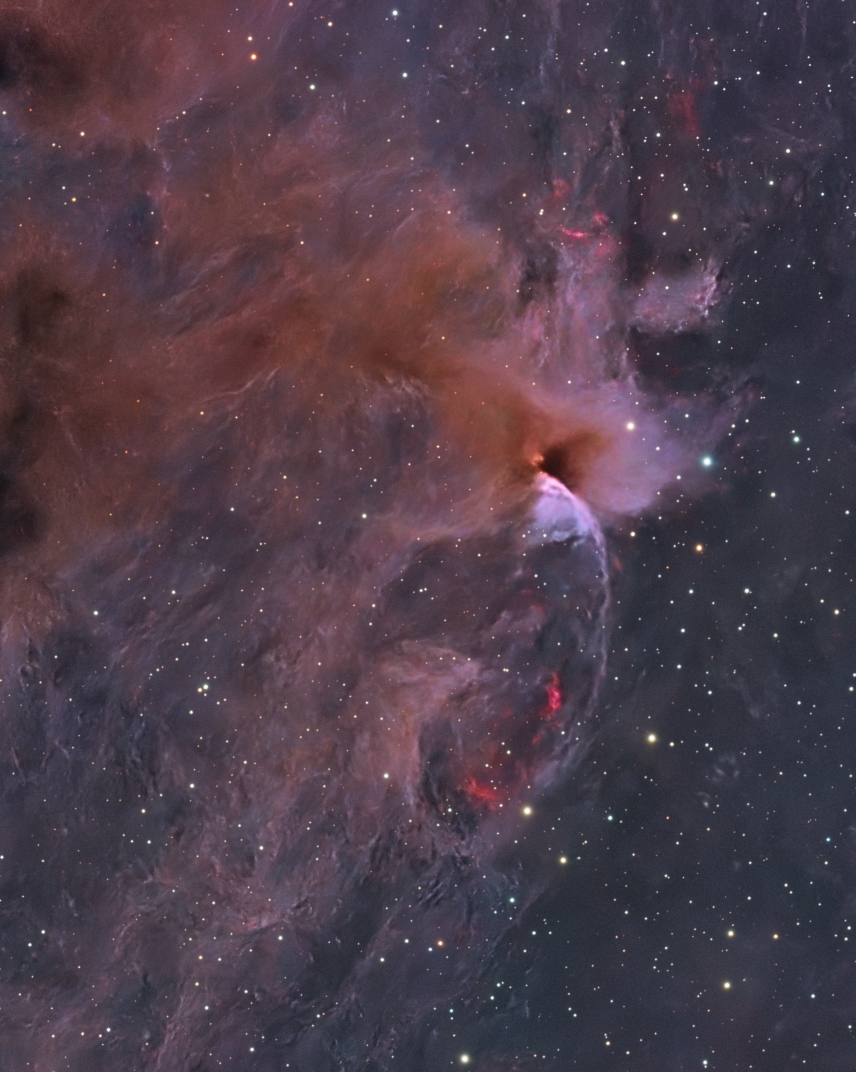
This picture of a protostar in its accretion phase in the coldest, darkest, highest pressure of a molecular cloud figures large in understanding how stars form.
Details of the image can be found in the posting on how gas bodies optically express themselves.
Introduction
This is the presentation that I gave at the 2026 Royal Astronomical Society of Canada‘s General Assembly this month (May 2026). I found that it summarizes the star formation process and how I interpret images fairly well and so I posted it here. I hope you enjoy.
Thank-you Charles, for your kind introduction.
My name is David Payne, I am a retired Professional Chemical Engineer, a member of the Victoria Centre of the RASC, and author of the aprealspace.com website.
One of my passions is taking and processing astrophotographs, and then scientifically interpreting them to figure out what is going on out there.
I’d like to thank RASC for this opportunity to talk to you today, and take you on a quick tour of how, by applying scientific principles, we can deduce how stars are REALLY made from molecular clouds.
Opening
The first image I would like to show is of a seemingly non-descript portion of the sky in Cepheus. All you see is some stars in what appears to be a vast emptiness.
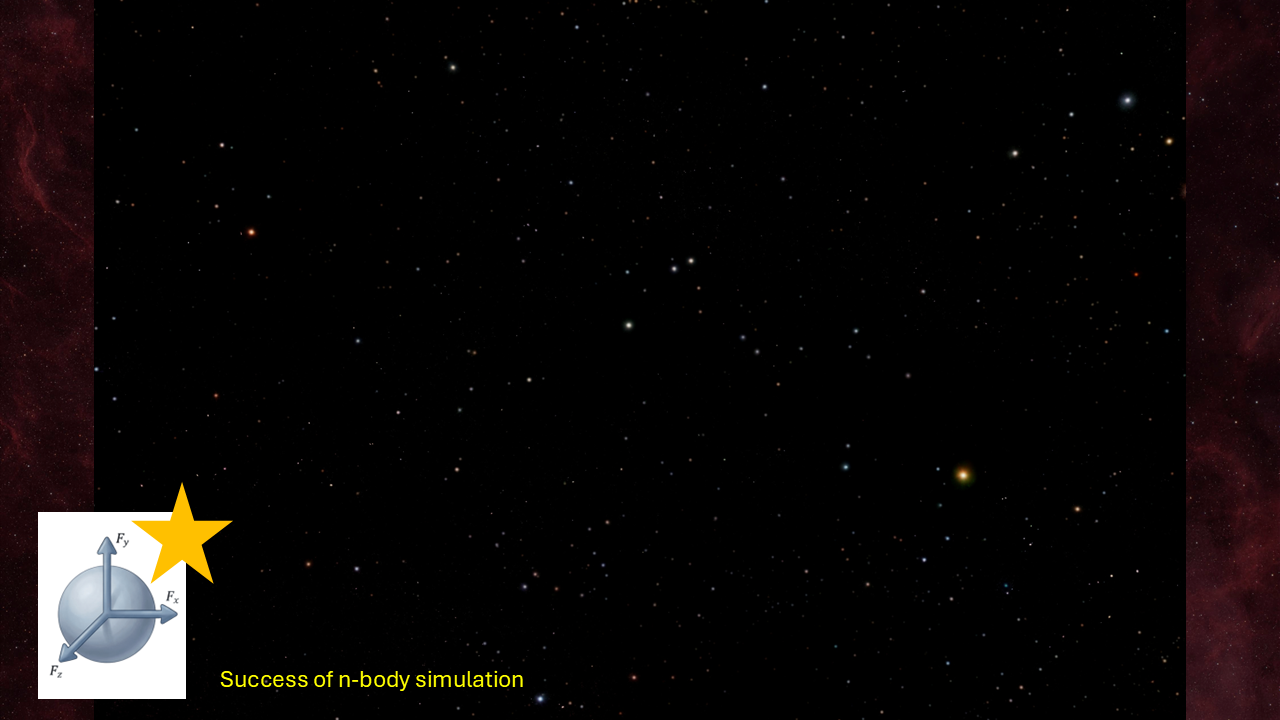
Astrophysicists are adept, both in precision and accuracy, at predicting star, planet, and spacecraft movement. They typically use an n-body simulator to solve ordinary differential equations representing body spacial positions over time as pushed by normal forces.
Stars separated by Space
But stars are only part of the story in space, what you don’t see is that there are gases that fills all the space that is out there. It is in fact, built right into the definition of what a gas is.
(Note that dark matter is considered gas which is likely what it really is in my mass consideration. Any way you look at it, stars are less then 10% of the Milky Way)
Filled with Gas
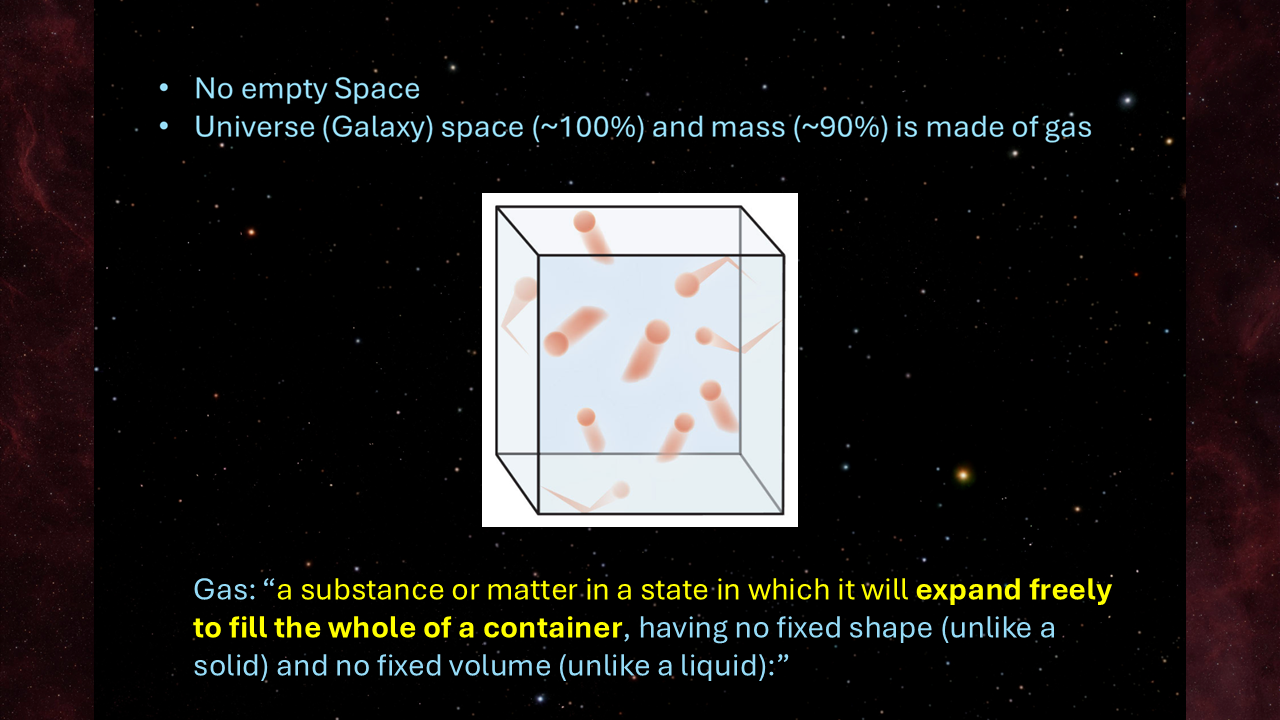
Our simpleist picture of what a gas is lies in the ideal gas model. We call it “ideal” because no real gas behaves in this oversimplistic way. but it does provide a concept of how a gas behaves – as a collection of particles perpetually moving in random directions with their own kinetic energy.
There are NO forces at a distance – gravity is far too weak and neutral atoms have no net electrical charge.
The only interaction between particles allowed in this model is the instant, elastic repulsion felt when two particles collide and bounce off in new, different directions.
Such collisions are the be-all and end-all of an ideal gas –it is collisions that don’t just allow us, but indeed force us, to group the atoms and molecules and treat the gas as a continuum body with not just statistical, but real, measurable, physical properties, instead of trying to treat them individually.
Temperature is the average kinetic energy of the particles while Pressure is the force that is created by particle collisions on one another and the walls of the container. They are related to one another through the ideal equation of state that says pressure is equal to particle density times temperature.
Astrophysicists have a love/hate relationship with gases. They realize that they need to model gas, but hate gas because mathematically it comes with an entirely different kind of equation to solve that breaks both their simulator and conflicts with many of their theories.
Idealized Model
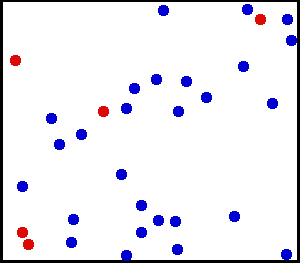
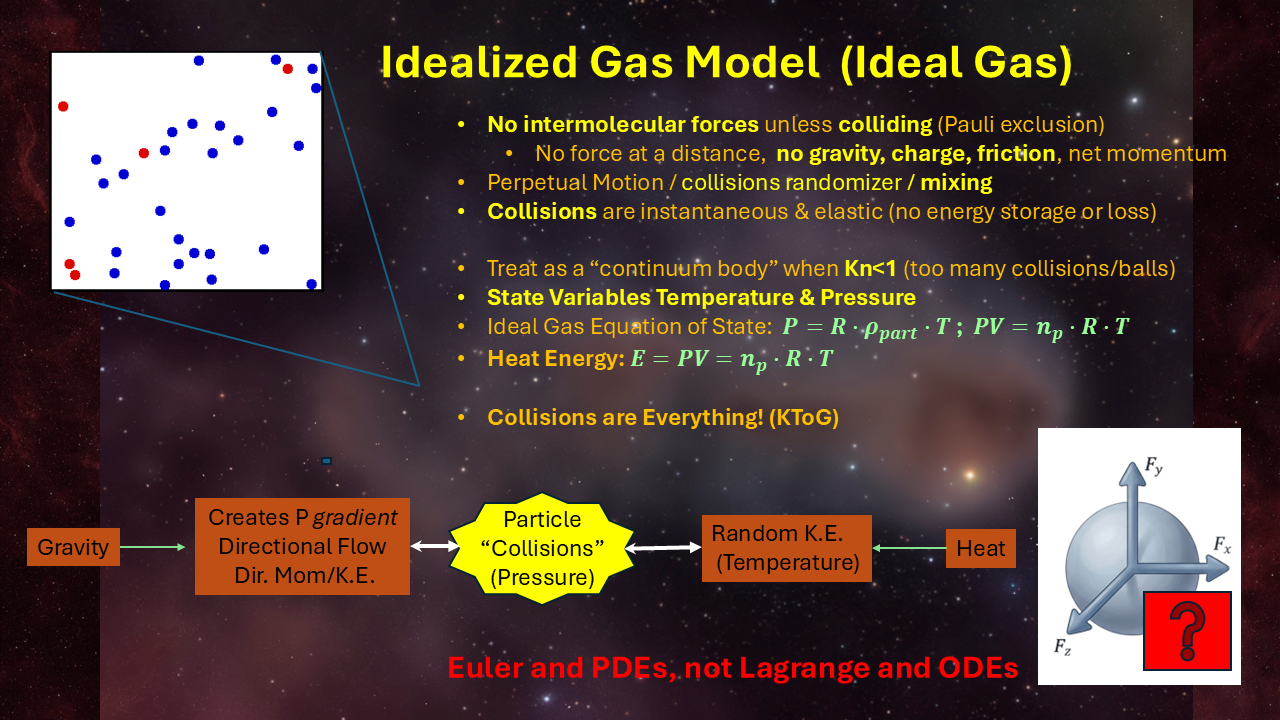
I too have a problem with an ideal gas because it is impossible to actually make a star out of it.
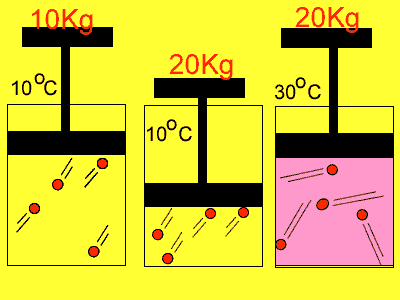
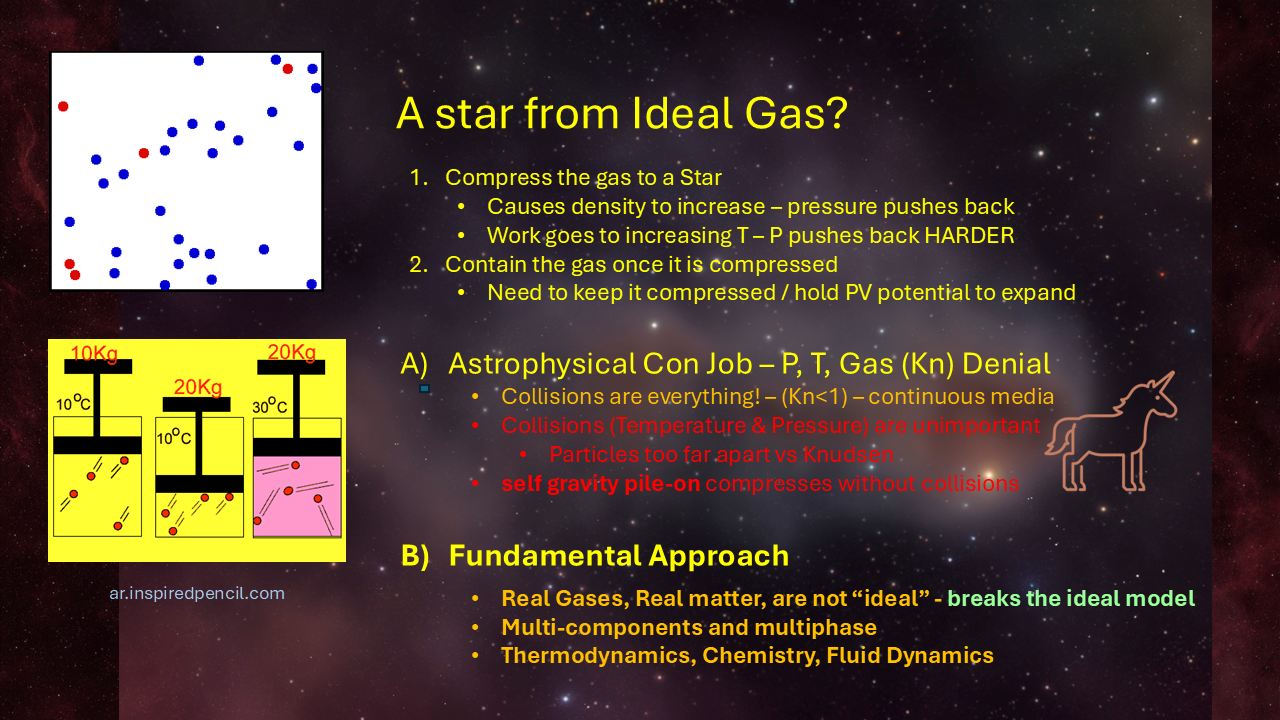
To make a star we must compress the gas particles into a very tight space.
The problem is that the harder we push, the harder the gas pushes back by pressure and temperature. It’s not that progress can’t be made, it is just that as we make progress it becomes even harder to do the work and there is no-one around to do it – just like emptying the dishwasher.
Finally, once we are finished pushing, we need a star sized container to keep the star from re-expanding, and we don’t seem to have a one at hand – maybe its in the dishwasher.
Any way we look at it, we find that there is something wrong with this ideal gas model, and we must fix it to progress.
The astrophysical approach is to say that the particles are too small and too far apart to collide to gets rid of this work problem. Astrophysicists further argue that gravity can overcome the original pressure and spontaneously collapse simply by making the gas body big. I’m just going to leave both these really bad assumptions alone for now.
Instead of this astrophysical unicorn, I am proposing here that we take a scientific approach and substitute real gases, and real matter for the idealized one. This will bring the full range of nature’s behavoir to bear on the problem.
Making a Star from an Ideal Gas
In a storied quote from Richard Feynman, in his attempt to write the most foundational sentence in science, he included a middle clause in his description of atoms that shows us what is wrong with the idealized gas model and its EOS.
The clause reads that atoms “attract each other when they are a little distance apart”. This is an addition to the repelling collisions and perpetual motion we discussed in the ideal model and, as it turns out, this combination of repelling and attracting changes EVERYTHING
Just for a start this attractive force at a distance will explain how the dispersion of gas can be countered by particles moving closely past one another to lend cohesion to the gas bodies.
Feynman Quote

Including this cohesive force turns our image from a diffuse mess into one that shows a great deal of fairly fine detail.
What our image looks like now, is what appears to be a smokey or dusty cloud being blown from right to left by the wind.
The reason it looks that way is because that’s exactly what it is, a molecular cloud being blown by a clear neutral, atomic gas wind. The cloud forms an aerodynamic shape that we call the rotting fish nebula, with rot or wisps indicating wind erosion from its surface.
Now, all of a sudden, we have both wind and the prospect of more than 1 kind of gas!. So what exactly is Feynman’s attractive, cohesive force that allows us to give us detail and make these observations.
The Rotting Fish Nebula - Detail Reveal

It turns out that it isn’t gravity – that is still way too weak, but it is in fact electromagnetic. Even net uncharged particles carry their charge in a dynamic distributed manner and it is the atomic structure that creates the attractive force.
This force breaks the ideal model by providing the mechanism for many of the observations we make down here on earth and seen in our images. Ultimately, it is responsible for the creation of the stars.
Molecules get cohesion when they pass close to one another, countering diffusion. In astrophotography we should equate blurriness to stillness, not out of focus and equate details to dynamics and movement, not in focus.
More importantly, this cohesion creates viscous drag by making it difficult for molecules to move past one another as the gas shears, as stated in Newton’s Law of viscosity.
Atoms no longer collide instantaneously, instead they enter an energy well that can hold the atoms or molecules close for extended portions of time – vibrating between attraction and repulsion or even between particle pairings like a square dance. In other words, the phase state of the particles can change to solid, liquid, or supercritical. This is how dust is made.
While down in the energy well, electrons can be traded or shared in one way or another to perform Chemistry – also necessary for stars and different kinds of gas
Other phenomenon includes life itself.
It certainly changes the way we need to treat and model these gases
London / van der Waal Forces


What we find is that there are really three types of gases out there, made up essentially the same atomic ingredients and differ predominantly by the chemical form of hydrogen in them and the prevailing temperature or collision energy that caused them to take that form. (Different atoms create different electromagnetic energy wells that collide differently depending on temperature and pressure)
At the hot and rarefied end, we have ions -largely invisible to our cameras.
When this gas cools we get atomic media a mixture of hydrogen atoms and molecules created through our newfound chemistry. The bad news….also invisible.
Even colder and most dense, the hydrogen atoms come together to form molecules – and we then call this gas a molecular cloud.
This gas would be invisible to us too, except for the fact that along the way of cooling, some molecules get caught in their energy well and condense to form solid dust particles.
These solid particles create a whole new ball game for imaging, because they can block, scatter, and reflect visible light. This allows us to finally see the gas.
By tracking the presence and optical density of dust, we can get a sense of where the molecular cloud is, how dense it is, and how cold it must be. Since this is the gas type that stars are made from, we should keep an eye on this one.
A Tale of Three Gases

Aside from the detail in our rotting fish, there is a star forming right in the coldest, densest, part of the molecular cloud. In addition, it is not occurring at the centre of mass of the fish body, but right in its head – the part facing the oncoming winds that is subject to the highest external pressure pushing on the cloud.
Perhaps a clue, but too little to prove anything yet, but it seems that cold, dense, and high pressure and thick dust have a role here. Nothing about gravity yet.
(note that the combination of a continuum (see my post on Knudsen number) and shear stresses/force from friction relegate n-body simulation to the unicorn realm)
The Rotting Fish Star

Ultimately gravity will be playing an important role in accumulating hydrogen upon a nucleated protostar, but we have to make the protostar first. – I promise I will mention gravity again.
For now, its key role is to create the winds that we see in our images. This is done through buoyancy. Under a gravitational field or other acceleration – lighter fluids will move in the opposite direction of gravity while heavier fluids pulled towards it.
These are the root cause of many of the non-stellar winds we see in our images, and buoyancy explains a great deal when deciphering what is happening in the galaxy.
A Role for Gravity - Buoyancy Winds

A second image of molecular clouds, in and around the Iris Nebula, also in Cepheus, provides a wider view of a larger molecular cloud complex in the wind, also oriented in such a way that the wind is blowing from right to left.
Molecular Cloud around the Iris Nebula

You have to admit that the molecular cloud in space blown by neutral atomic media looks a lot like wispy clouds blown in the sky by air, wisps of smoke coming off of a tail pipe, or flow patterns that we can duplicate and see in a lab.
All of these patterns require viscous drag, friction, and winds to be realized – all pointing to our real gas replacement with its attractive force and friction.
If it Quacks like a Duck....

Not only the wisps, but larger scale structures, such as mushroom clouds can also be seen both in the molecular clouds and on our planet – resulting from multiphase countercurrent flow with viscosity.
(aka Raleigh-Turner or Raleigh – Taylor instability in countercurrent flow)
Iris Area Larger Scale Structures

There are stars being created here too. Both of those found in this image are occurring at the upwind side of molecular clouds where pressure is highest, and the cloud is densest and coldest. I think there is a pattern forming here.
Note the simiiarity of the left hand structure and position of the its new star with that of the rotting fish.
In the right hand inset, the cloud is more in the shape of an arrowhead, and the large whisker coming out of it is call an Herbig Haro jet, that is diagnostic of a new star forming.
Iris Area has Stars Too!

If we want to find a lot of stars forming in a single image, we should naturally turn to what we call a stellar nursery. This image is of one called the Clamshell Nebula and is taken with narrowband light, which makes all three kinds of gas visible to our cameras given the right circumstances.
Stellar nurseries are formed when one or more large “mother stars” are created deep within a large molecular cloud. These mother stars burn very bright and create strong stellar winds that blow an ionic gas bubble with the cloud and displaces the molecular gas away. When the ionic gas loses directional momentum, buoyancy takes over and the gas creates a route through to the outside and a hole in the cloud that we can see into.
The Clamshell Stellar Nursery in Cygnus

Another similar process takes place when a volcano erupts, bubbles and buoyancy in the magma cause the eruption. This insert is of a recent eruption of Kilauea on Hawaii and although the geometry is different, the image is replete with similar features of heated material, gases, and even dust.
The Clamshell vs, The Volcano

We even see instabilitities in the form of viscous fingers, that we see in low diffusivity porous media, whenever we displace a more viscous fluid, in this case, molecular cloud by a thinner one – ionic media.
(aka – Saffman-Taylor displacement (co-current) instability, but no-one calls it that, just viscous fingering.)
Viscous Fingers

It turns out that while new stars are being created throughout the inner surface of the molecular cloud, nowhere moreso than at the tips of these fingerlike structures.
We can see them forming at the tips of the Elephant Trunk Nebula, the famous pillars of creation in the Eagle Nebula, and at the tip of this finger in the Pelican Nebula – note the diagnostic whiskers of bold Herbig Haro jets.
These locations, aside from being dust rich, dense, and exposed to high pressure on multiple sides are actually still very cold thanks to the dust that blocks heating light from the stars, and yet still cools via infrared radiation of its own.
All of these parameters that we see in common in our images point strongly to a thermodynamic cause for cloud collapse and star formation.
Star Formation in Stellar Nurseries

It turns out that while new stars are being created throughout the inner surface of the molecular cloud, nowhere moreso than at the tips of these fingerlike structures.
We can see them forming at the tips of the Elephant Trunk Nebula, the famous pillars of creation in the Eagle Nebula, and at the tip of this finger in the Pelican Nebula – note the diagnostic whiskers of bold Herbig Haro jets.
These locations, aside from being dust rich, dense, and exposed to high pressure on multiple sides are actually still very cold thanks to the dust that blocks heating light from the stars, and yet still cools via infrared radiation of its own.
All of these parameters that we see in common in our images point strongly to a thermodynamic cause for cloud collapse and star formation.
Star Formation in Stellar Nurseries
Isaac Newton developed his shell theory to explain how gravity works in any spherically symmetric body. One of the counter-intuitive things Newton says, is that for any constant density body, the strongest gravity is found on the outside. Furthermore, the gravity at the centre of any body is zero.
In my view, this is initially disturbing, because we have been led to ask the wrong question all along. We shouldn’t be asking what is it that keeps a star from collapsing under gravity, we should be asking, since gravity is weakest in the middle – how does weak gravity stop a star from expanding!
Newton's Shells

This is the essence of the containment problem we discussed at the beginning. Not only is it impossible to make a star out of a gas, but it is also impossible to keep it from expanding once you have created it.
The answer to this is laying beneath our feat all the time. The earth itself is a spherical body, with zero gravity at its centre, and maximum gravitational pull at its surface, yet it doesn’t expand, despite a hydrostatic pressure gradient within it.
Most of the earth, is simply not a gas at all. Instead it is made of a condensed incompressible material, that holds its gaseous atmosphere on the outside by gravity. Its molecules are held together in that attractive/repulsive energy well that we spoke about.
It may seem to you that we are getting farther away from our goal, but we are very close – just a couple of receipts and one more concept – the experiments of James Joule.
A Non-gaseous Protostar must Pre-exist - the Containment Issue

What Joule did were experiments in an insulated two chamber vessel and watched the gas under pressure expand from the left hand side into an evacuated right hand side.
What he found is that while the gas would expand to the empty side and eventually equate pressures, there is no way he could urge that gas to return to the left.
I wonder if somewhere, there is someone (an Astrophysicist!) with Joule’s vessel waiting and watching for spontaneous collapse to happen and waiting for the right wavelength perturbation to bring it on.
But gas expansion is irreversible, and spontaneous compression is a felony under the 2nd law of thermodynamics, that says Entropy must always increase, or delta entropy must always be positive.
On the left I have written the pertinent formula.
Joule Expansion - What they don't teach in Astrophysics.

To this, astrophysicists have double down by saying that Joule just didn’t make the chamber big enough, and by this they inconveniently mean the size of Jeans’ length – an astronomical size that could never fit in a lab
So I went about correcting some of James Jeans’ math errors on both gravitational potential (he had the wrong sign, incorrect integration) and on thermal potential (Carnot heat engine), and determined that not only does gravitational collapse still violate the 2nd law, but it actually makes the entropy story worse. Even discounting the PV work needed to compress the gas, self-gravity alone cannot collapse it. Its only spontaneous route is expansion.
It turns out that all that gravitational potential must end up ultimately as heat by conservation of energy, resulting in potential to expand!
At least this result is entirely consistent with Newton, if not with astrophysics.
Joule Expansion - Make it Big Enough for Self-Gravity

Fortunately, we do have thermodynamic alternative that takes just a smidgen of imagination and a slight modification to Joule’s experiment.
Imagine the right-side chamber represents the outside of a molecular cloud, while the left represents the inside. If we add some dust to the left side and allow it to emit Infrared heat to deep space, the temperature of the inside will cool below that of the RHS or the outer part of the molecular cloud. This will cause a pressure gradient and gas to flow from the outside inwards and build density there. Meanwhile heat is shed to deep space and entropy is able to grow.
If the centre side gets cold enough, more dust will form, crystallize and accelerate the process, with ultimately, the condensing of helium and hydrogen molecules.
You can test this theory yourself, simply by getting a drinking water bottle, one of those plastic flimsy ones. First drink the water, then put the cap back on, and finally throw it in your freezer for half an hour. Voila – you just collapsed a molecular cloud. You will likely also see condensed water “dust” either as a fog or on the bottle’s inner surface.
A Thermodynamic Alternative

What we are describing here is a three step process to create a star involving
- 1) Cloud collapse by radiation cooling
- 2) Condensation of first more dust, and finally condensation of hydrogen & helium into either an incompressible liquid or solid to nucleate a protostar that can contain itself.
- I will pause here to say that the high external pressure on the cloud provided by winds from either buoyancy flow OR direct hot stellar winds will speed the collapse process and by raising absolute cloud pressure, lowers the temperature required to achieve hydrogen condensation.
As density at the centre of our cloud increases, gravity – starting from nil, eventually becomes at least helpful at accumulating additional material from the remainder of the cloud
- 3) The third Step, once the protostar is massive enough, is to shift to gravity accretion. Here the gravitational force is largest at the protostar surface and overpowers a pressure gradient. Material can collect on the protostar as a low compressibility supercritical (non-gas) fluid directly from the gas phase.
Three Steps in All

We can ground-truth our theory by mapping our three steps onto a phase diagram of hydrogen, and indeed we find that the temperatures and pressure fit to what we observe about hydrogen in the lab and when and where it condenses.
Furthermore, a path can be drawn such that once hydrogen leaves the gaseous state in the lower right of our diagrams, it need never become a gas again, even when it is heated up by fusion. It can always contain itself against zero gravity at its centre.
(note that the key to keeping the protostar out of the gas phase is to move to the left of the critical point.)
Ground Truthing with Phase Behavior

I won’t go into detail on the condensation process, only to say that this is a similar to that industry uses to create liquid hydrogen for rocket fuel – they certainly don’t collapse it in a centrifuge or by gravity.
Note that this same thing applies, not only to stars – but to both rocky and gas giant planets. Maybe we call them what they really are – supercritical giants instead.
But there are also subtleties, like how any turbulence can decouple dust from the gas to aid in its thermal emissions and crystallization.
More About Condensation

I have glossed over the accretion step too. But I do need to mention the extremely important role that viscous friction plays in letting hydrogen reach the protostar without simply orbiting it. It is hard to throw anything into the sun due to angular momentum, and viscosity drag provides a force to dissipate it to heat.
One last point, regarding angular momentum, protostars gian the ability to shed additional angular moment once hydrogen reaches its surface and moves toward the poles. This method involves the creation of those Herbig Haro jets that we used earlier to diagnose star creation.
More About Gravity Accretion

So that’s it, I believe I have vanquished any unicorns and presented a more plausible explanation for the creation of stars, using astrophotographic interpretations to set the stage for real science that includes thermodynamics, real gases, fluid dynamics, and friction.
Conclusions

If you are interested in more details or more explanations of other space phenomena, please visit the images and blog posts at SPREALSPACE.COM. If you are interested in a discussion or providing constructive feedback, please contact me at david@aprealspace.com with your thoughts and ideas.
Thanks for your attention and I’d love to field any questions.
Questions - Visit "aprealspace.com"

Backup Slides and Time Wasted on Jimmy Jeans


One last sarcastic slide, as pay back to the gym teacher’s comment at the presentation….LOL


