
Video Post – How Friction Creates a Galaxy’s Spirals

Video Post – How Friction Creates a Galaxy’s Spirals

The videos presented here represent a culmination of my analysis of spiral galactic structure.  The conventional explanations of how spiral work try to shoe-horn the partial differential equations of Navier-Stokes and Maxwell, into the ordinary ones of astro-physicist’s simulations and this leads to gross misrepresentations.  It is like an illness in the popular scientific community that is directly related, although less political, to the climate simulators and their ODE simulations of our dynamic, convective atmosphere.  “Unicorn” constructs, such as gravity density waves are really how the ODE solutions are tricked into giving realistic results.   Shortcuts to PDEs, such as “Ram Pressure”, are elevated to the position of real explanations.   There videos take a overview look at how spiral galaxies really

The Sunflower Galaxy and Dynamic Complexities

The Sunflower Galaxy and Dynamic Complexities

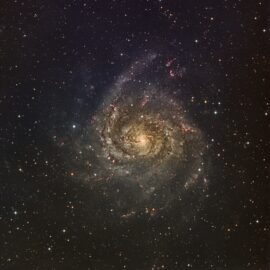
At first glance, Messier 63 (M63 for short or aka “the Sunflower Galaxy”) appears to be a break from the traditional spiral structure of galaxies and represent a new type of galaxy termed a “flocculent” class.  It was thought that the stars formed clumpy clouds gathered together as clumps, like strands of wool form clumps of wool – even on the sheep.    In chemical engineering, we often use agents that make particles suspended in a fluid clump together to form larger particles ,so that gravity can overcome the suspension and separate the particles from the fluid.   I like to thing that the word flocculate (or its sorter “floc”) comes from the word “flock”, as in a flock of sheep,

Star Nucleation Amped Up by Tidal Effects

Star Nucleation Amped Up by Tidal Effects

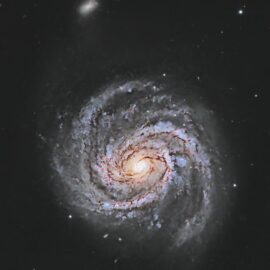
Spiral galaxies can vary widely in the amount of stars they are generating. It is asserted that star nucleation, via the imposition of high pressure over small volumes of molecular cloud, is the rate determining step. Turbulence of molecular clouds in galaxies is greatly increased when the chaotic, but stable, spiral galactic structure is disturbed by tidal effects of nearby galaxies. In this posting, the three main galaxies of the Leo triplet are used to illustrate and link the chain of events from tidal influence to rapid star production in the galaxies we image.

The Hidden Galaxy – Now you see it

The Hidden Galaxy – Now you see it

IC342/Caldwell 5 – The Hidden Galaxy in LHaRGB Planewave CDK 12.5in; AP 1100GTO AE; QHY600M, – Baader Cmos Opt Broadband and 6.5nm Ha FiltersL: (50 x 180s, Bin 1, Gain 100); H: (29 x 720s Bin 1, Gain 100); R,G,B: (25,23,22 x 210s, Bin 1, Gain 100)Total integration time = 12.4 hrs (Feb 10-12, 2025) Maple Bay, BC, Canada For full resolution, downloadable image, visit my gallery at Victoria RASC Zenfolio or Astobin The Hidden Galaxy gets its name from its position in the sky, near the Milky Way and partly obscured by our galaxy’s dust.   If not for the dust, IC342 would be visible with the naked eye and occupy about the same size as the moon. In reality

The Whirlpool Galaxy (M51) – In for Questioning

The Whirlpool Galaxy (M51) – In for Questioning

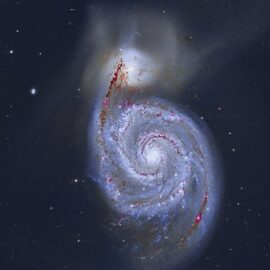
The M51 Galaxy or “The Whirlpool Galaxy” definitely strikes an awsome pose, with its two apparent “centres”, and multiple star fuzzies emanating from its extremes. I decided to get all Sherlock Holmesy on it in my desire to figure out what was going on. Yes it is two glalaxies interacting, but what is the nature of this interaction. What happened to its bottom arm? – it looks like it was bitten off. The upper arm looks more intact, but also exhibiting Halpha starburst too. Is the bottom of the galaxy connected to the top with stars circling the left hand side? Can infrared light help us? Can it potentially reveal something? I recommend reading more to find out.

Stars are born – Have a Cigar

Stars are born – Have a Cigar

In an everyday spiral galaxy (ho hum?), every effort is made by the galaxy itself to minimize the amount of energy wasted on forming turbulence of dust and hydrogen. As a result, areas of intense star formation in a regular spiral is usually restricted to a discrete points along the spiral arms where ISM and molecular cloud rub against each other to create the turbulence. These limited areas of star formation are seen as patches of bright red Halpha emissions. In this image of the Cigar Galaxy, it is evident that something has thrown “a wrench/spanner into the works” and created a hell of lot of turbulence, resulting in a fireworks display of red Halpha. When this occurs, stars are created at a very high rate and we reclassify such galaxies as “starburst” glaxies and the Cigar is one of them. Still, the original stars and dust lanes of this once regular spiral can be made out.