
The success of n-body numerical simulation to predict the motion of planets and stars cannot be denied. At the same time, the erroneous application of these model to intra-galactic objects and galaxies themselves have led to a popular narrative that is full of magic and other non-sense. In this ambitious posting, I have put together the astrophysical data in a different way – one that looks at objects from a more scientific and engineering point of view. This data has been used to show that the various objects in space should be considered as continuum bodies, rather than collections of particles. Classical physical laws and concepts are used to show how and why many of the phenomenon we see and
Anatomy of the Orion Nebula – Imaging and imagining 3-D Gas Bodies

It is easy to forget that our 2-D images are actually representations of 3-D gas bodies, that are acting according to 4-D dynamics. In day to day life, we have many clues that we can rely upon including parallax views, perspective rules, lights and shadows, and actual physical interaction that we can use to assess the nature of objects in 3-D and 3+1 space. Unfortunately many of these clues are absent or confusing in our deep space objects. In this post, we analyze a 2-D image of the Great Orion Nebula and stellar nursery including its shape and orientation in 3-D space. Along the way, we will present an understanding of the three principle gas types in deep space photography
Thermodynamic Cloud Collapse & Me vs Gravity & Grok

Since I began working on this website, I have been using AI to fetch equations, data, and history. In general, I don’t bother discussing things much with AI, because typically AI relies on authority – number of journal articles, citations, simulations, status indicators, and other non-scientific bases to form its opinions. Me, on the other hand, I take the Richard Feynman philosophy that “Science is the belief in the ignorance of experts“. If AI believes you are straying from its narrative, it tries to “correct” you and actually let you know that what you are asking for is wrong. It finds something it agrees with, and then, tries to interject that it was at least somewhat right all along. It
Abell 39: A planetary nebula and the most perfect sphere in the night sky

Discover the mesmerizing beauty of Abell 39, a planetary nebula renowned for its stunning spherical shape. While many nebulae are complex and chaotic, Abell 39 stands out as a rare gem in the night sky. This article delves into the fascinating evolution of stars, from their fiery beginnings as main sequence stars to their transformation into white dwarfs and the breathtaking nebulae they leave behind. Join us on a journey through the cosmos, exploring the intricate processes that create these celestial wonders and the vital role they play in the universe’s grand tapestry.
The Anatomy of a Stellar Nursery

Introducing the Rosette Nebula / Stellar Nursery When I first started to image stellar nurseries, I really didn’t know anything about them. I was told that stars are being born there – that is pretty awesome, but I was curious what was it about these light generating molecular clouds (MCs) that made them prolific star builders. Sure, stars are also created in turbulent dark molecular clouds, but stellar nurseries really churn out the stars at a much higher level – often creating whole open clusters of stars. Many of the stellar nurseries get very large and can even be mapped from their Halpha light signal in other galaxies. Ok, so my interest was piqued – I had to figure out
Fueling up a New Star – Gravity vs Angular Momentum

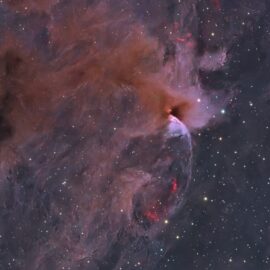
In order to grow, a nucleated (condensed), cold star core must accumulate hydrogen as future mass and fuel before igniting to fusion and becoming a full fledged shining star. But there is a problem in the way. Just as the sun cannot accumulate planets via gravity, without some mechanism to shed angular momentum, hydrogen will just orbit the baby star and not accumulate upon it. Viscous drag both dissipates angular momentum and allows hydrogen molecules to accumulate by spiraling down to the star. Unlike a planetary orbit, in a spiral gravity, angular momentum, and viscous drag (friction) are not orthogonal to one another, allowing friction to dissipate momentum as the gravitational fall increases it. Upon arrival at the star, there remains a lot of angular momentum that still need dissipating. Compressed, hot hydrogen forms a metallic core on the star where it creates an electromagnetic magneto – a sort of electric motor. The magneto converts angular momentum into linear momentum that squirts out as jets from the poles. Both mechanisms allow hydrogen to accumulate without spinning the young protostar to death. The jets also advertise to us that star formation is going on and results in beautiful images.
The Cave Nebula and Hydrogen’s Journey

One cannot understand the creation of stars from molecular hydrogen clouds any more than one can understand the weather here on earth without reference to thermodynamics. The weather is largely driven by water in gaseous (vapour), liquid (rain, clouds) and solid (snow, ice and ice crystals) forms. Knowing the pressures and temperatures at which these physical phase states occur is fundamental for both water in its role of creating weather, and for hydrogen in its role of creating both stars and the galaxy itself. Every atom and molecule of hydrogen must undergo and piecewise continuous journey through its phase/space – there is no leaping allowed, and the conditions must exist somewhere in a system for phase transitions to occur.
In our description of galaxies, we discuss the atomic and molecular phase states of hydrogen, but here we illustrate and explain the rest of the phase/state journey that hydrogen, at least at the nucleus of a star, must undergo to enable star formation. This is a journey from molecular gas all the way to becoming a hot, molten, liquid metal.