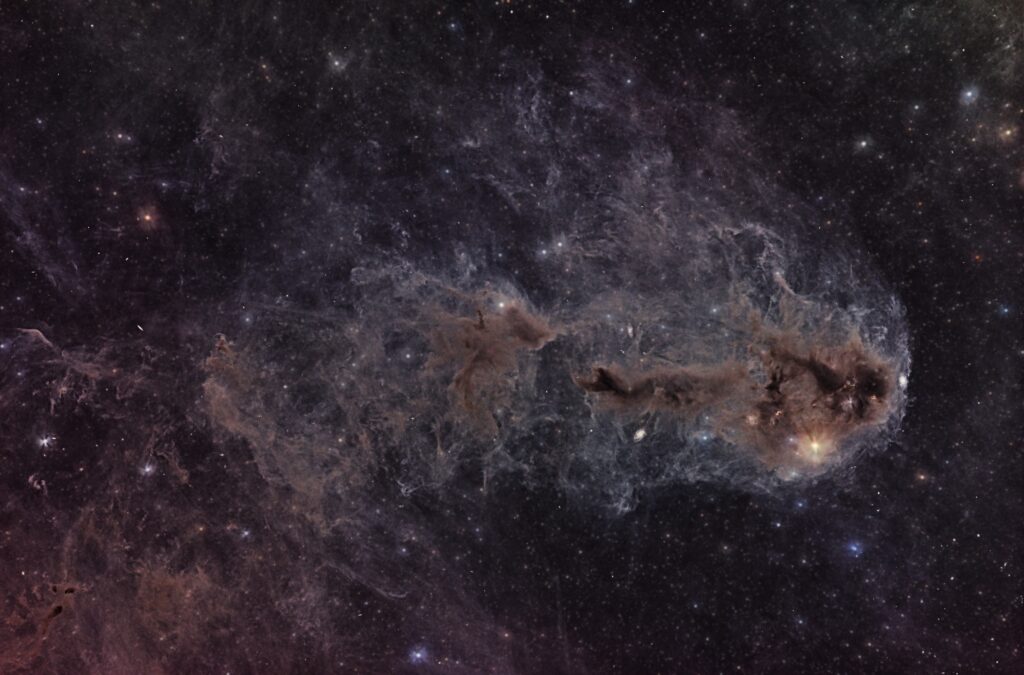

Globular clusters (GCs) of stars are some of the oldest collection of objects that we can see in the night sky. Yet, as we shall see, they actually form a dynamic system that is fundamentally chaotic. This is counter to our intuition that associates chaos with a random, formless, unpredictable mess and anything but longevity. Indeed, there is a lot of unpredictability and counterintuition associated with globular clusters, but as a whole they are able to withstand billions of years of random-like behavior to emerge as consistent, enduring, metastable entities. GCs are a great example of how order can endure in chaos, and how being metastable often means being stable enough to last.

M5 Globular Cluster in Serpens
R,G,B: (36,41,37 x 180s, Bin 1, Gain 100)
Total integration time = 21.4 hrs (Apr 27, 2025) Vancouver Island, BC, Canada
Great care is needed during the processing of GC images to preserves star colour and resolution while avoiding blow-out of brightness in the core (due to the density of stars there). As you likely know, since our eyes don’t work so well on linear data, we have to “stretch” the brightness of pixels in our astronomical images non-linearly for our eyes to perceive them more naturally. To do this, I used GHS stretching to control both brightness and saturations that did lead to a funny shape/colouring on the bright double star below M5 in the image.
Otherwise, you can see that the globular cluster is just that – a cluster of stars in a spherical shape with a graduated star density as you move away from the centre. The stars at the outside of the cluster seem to just blend with the other stars in the Serpens constellation.
M5 lies 25,000 light years distant and the mass of stars amounts to 857,000 times the mass of our sun. The accepted diameter of M5 is 165,000 light years which is a good approximation of distance at which an ambling star might get gravity locked into, and join, the cluster.


M13 The (Great) Globular Cluster in Hercules
Askar 151phq Refractor; AP Mach2 Mount; ASI6200MM, – Chroma Broadband Filters
R,G,B: (33,36,30 x 180s, Bin 1, Gain 100)
Total integration time = 5.0 hrs (Apr 26, 2025) Vancouver Island, BC, Canada
It is apparent that the M13 Globular Cluster is very similar to M5, above. Both are about the same distance from us, and M13 is very slightly larger at 168 lys diameter. Of the two, however, M13 contains the most stars at around 400,000 versus the 250,000 stars attributed to M5. Maybe this is why M13 deserves the word “Great” in its moniker. Of course that means the stars are more tightly packed in M13, which star densities estimated at 28 stars per cubic light year. While densely packed for stars, that is only 6.5E-17 kg/m3 for you and I, so calling it crowded would be a big stretch.
As with all globular clusters, both M13 and M5 are very old, and compose 2 of the 150 to 160 globular cluster that are found in the Milky Way. Some of the stars in the cluster are undoubtedly originals, allowing astronomers to study long term star evolution fairly close to home. Most clusters are indeed associated with galaxies, but they are found generally in the halo of stars that exist outside of the galactic plane, although they may orbit through it. They do not hold much galactic gas and, like stars, they are influenced by the complex gravitational field of our spiral galaxy, but not to the fluid mechanics that create the spirals. As a result, globular clusters are not associated with the galactic arms like the very young stars that are created in them.
It can be surmised that globular cluster were either created outside of the galaxy, or within galaxy under conditions that no longer exists. Having no gas or dust, there is no longer any star creation going on in these cluster and, together with its much smaller size, distinguishes GCs from dwarf galaxies. At the same time. the blue colour of many of the stars suggest that they are much younger (or behave much younger) than the cluster itself.

Orbits and Non-linear Dynamics
An initially satisfying, but grossly oversimplified functional model of globular clusters is that of a dense cluster of stars mutually orbiting its combined centre of mass, much like the earth orbits the sun, or the moon orbits the earth. If you dare, however, I would like to open up a pandoras box that will change the way you view the universe and the granularity with which we can understand it. To build on the metaphor, there are a lot of dragons that will start flying out that box, that I will attempt to slay, tame, or at least point you in a direction where you can later slay for yourself.
Our first foray into orbits and non-linear dynamics involves the circular orbit of a planet around a star, long after the star’s winds have blown away most of gases and dust left over from its creation. Along with that, we have to make a couple more assumptions – that both the planet and the star act as point masses, are not deformable, and that any other forces or bodies have no impact upon them. All these assumptions are our shields from the onslaught of dragons.
What this diagram (Credit: The Open University) illustrates is that the planet does not so much orbit around a star, as both orbit around the centre of gravity which is a sort of mass weighted average position of two bodies. There is not necessarily anything at this virtual point in space, but it does form the focal point of the orbiting bodies that create it.
There is, of course, an analytical solution (no computer needed) to describe this system. Where the two bodies will be at any time in the future (or past!) can be determined by the knowing their starting positions and relative momentum. The uncertainty of being able to forecast the future is only limited by the knowing the now – the error bars wont grow over time.
The answer of how two bodies will move relative to one another become a two dimensional problem in a plane, even though the centre of mass can move through three dimensional space – provided we start with the absolute momentum of both bodies.

The dynamics of the such a two body orbit is non-linear – despite the simplicity of the differential equations that govern it. It is that pesky r-squared term in the gravity equation that creates this non-linearity by making the solution quadratic. The motion shown here periodic repetitive (or periodic) for either a circular orbit pattern or more commonly elliptical and because the two entities we might even call it a solar system. In reality, any conic – including parabolic or hyperbolic orbits are allowed, if say, the initial velocities we measured were at or above the gravitational escape velocity. In such a case, the association of these two bodies will only be fleeting and as far as our “solar system” is concerned, true orbit will not be achieved. Our solar system would be considered unstable as a body, but our forecasts of where the particles will be will remain rock solid.

Our stable co-orbit doesn’t have to be concentric circles, nor do they have to be a solar system – two stars can continue to orbit one another provided their orbits form a closed conics. Although the paths appear to cross in these elliptical orbits, the stars will not generally “collide” – they will always have their centre of mass between them and travel in the same orbital direction. In a two body system, the centre of mass will be static.
I am sure many stars in the globular cluster, at least for a period of time, pair off in this manner. When the orbits are very tight, we consider the system a double or binary star and such stars were likely very closely bound right from their creation. It is quoted that every star you see has a 20 to 30% chance of actually being such a double star, if you can resolve it. and you don’t have to look far to resolve many in our images. Still, there are likely many stars within the globular that pair off as in the diagram that aren’t considered double stars – simply because of their orbital distance.
The key to stability of this system is that the centre of mass does not move (in relation to the stars) throughout their orbit. In the above figure (Credit: Centre of Astophysics and Supercomputing), the heavier star is on the right (closer to the centre of mass). The relative orbits will be maintained as long as there are no dissipative forces that cause one of the stars to decay its orbit and as long as another body doesn’t enter the system to pull on the centre of mass.
The simple system of two co-orbiting bodies can set up a complex gravitational field as shown in the acceleration contours show in the figure at right (Credit Data Science Cental). Hills, valleys and saddles (aka Langrange points) exist that are potentially more or less stable places where a third body can exist in our dual body system. We exploit what is called the L1 and L2 saddles to place satellites in a “more stable” saddle point – one example of which is the JWST telescope at L2. This works because the JWST is small and doesn’t upset the apple cart by imposing its own gravity.
Of course, our solar system contains many other planets but they are quite difference and only create a wobble, which, for some, is how we first learned they were there. The moon(s) as well complicate the system somewhat, but as long as they are not too large, the systems overall stability is not compromised by moving the overall centre of mass of the galaxy.
In our stellar orbit, it is only when three, comparable bodies that chaos really ensues and life gets spectacularly interesting.

The Three Body Problem
Don’t panic, we aren’t going to add all 300,000 stars to our model one at a time. It is just that, when we add our third star, we lose (at least in general) our ability to precisely predict where any of the three stars will be in the future. The addition of a third star creates a set of differential equation to which there is no closed solution, (except in a few special cases). This system of three bodies, presents a chaotic system, where we have to give up all hope on forecasting the details.
The longer in the future we want to predict the prosition and speed of individual star, when there are three or more of them, the less accurate our predictions will be. At the same time, precision in knowing the starting positions and momentums of the stars is little help. Slight differences in initial conditions can rapidly result in very different forecasts. You may have heard of chaos theory as the “butterfly” effect where the beating wings of a butterly ultimately determines whether a hurricane will develop or not.
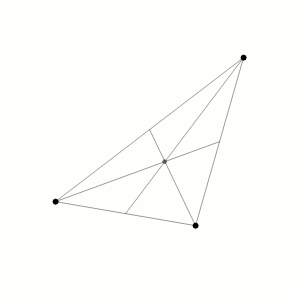
The image a left presents an example simulation of the “three body problem” (Credit Wikipedia). It is readily apparent that one cannot predict with any certainty, where the three bodies will be or their momentum after only a short period of time. Coloured lines are used to trace their chaotic trajectories, limiting our ability to describe the system. We can say a few things about it though, as in the fact that there is a limt to how far away any body can move away from the centre of mass and that the centre of mass will not move. These are higher attributes of the body itself, but we must give up on the “Qualitative is nothing but poor quantitative” notion because clearly, there is only so quantitative that one can get.
The situation seemingly gets even more complicated if the bodies are of unequal mass, if more bodies are added to the system, or if new bodies enter or leave from afar.
From all the way back to Isaac Newton, many have tried to solve the three body problem and failed to get a general closed solution. One of those who tried, ended up being, considered the “grandfather” of non-linear dynamic systems was Henri Poincare theorem, that stated, in albeit more precise thems, that there is integral solution to the governing differential equations that govern such non-linear differential equations (1890). That was a real wake-up call to science – that there was a limit to how you could understand and predict the future.
All is not lost, however, as Poincare and later Lorenz (without a t this time) developed techniques for understanding chaos that allow us to view patterns, and analyze the organization that spring from chaotic systems. These techniques actually can give us a better understanding of how things work by tracing the trajectories of the state variables of system. By looking at the phase state of a chaotic system over time, or many times with differing initial conditions – the beauty and order that springs from chaotic systems is revealed to us
As the double pendulum swing at left swings (Credit Wikipedia again), it begins to show us a pattern. If simulation were extended, we can actually determine a probability density function that would tell us the likelyhood of where we might find the end of the pendulum at any given point in time. We do have to give up on the notion of actually knowing, even approximately where it actually will be at any time.
If you are getting shades of quantum mechanics here, then that was intentional.
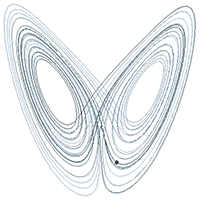
One final example, involves at attept by Lorenz in 1963 to simulate three components of atmospheric convection governed by three ordinary differential equations. One day, his simulation failed to duplicate a previous simulation result. Later he discovered that his had left out an insignificant decimal place in his initial conditions, but this entirely changed his weather forecast. The result, pattern or phase diagram for his system (at right, credit Wikipedia #3) generated by the non-linear dynamics became emblematic of chaos and the order that springs from it.
Today, the analysis of non-linear systems, including chaos theory, is a mainstay of advanced science and engineering including of course astronomy and cosmology, but also fluid mechanics, process control, weather forecasting, biology, and economics. (everywhere except climate science, where it is not understood at all).
It seem I should not get back into topic and it is time to add the rest of the 249,998 stars to our globular cluster.
Three's a Crowd
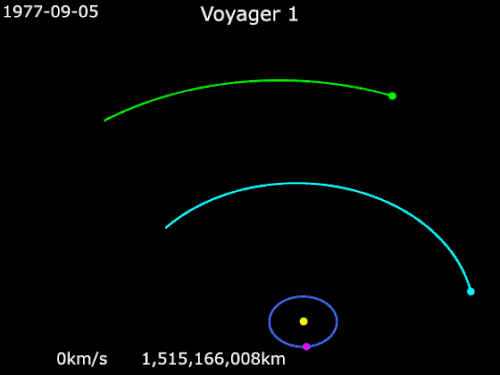
You may be familiar with the use of gravity assist to allow our spacecraft to gain velocity to visit the far reaches of the solar system and potentially even beyond. It may even have been explained to you, as in the figure at left (Credit Wikipedia yet again) that the spacecraft is stealing kinetic energy from the orbit of a planet to increase its own speed, kind of like a lever or a trebuchet.
That is almost the truth, but the technical explanation is that the kinetic energy comes from the planet / sun co-orbiting pair – as we have discussed above. The other part that is of interest, is that the process of gravity assist actually slows down the period of the co-orbit and actually brings the planet and sun closer together.
The satellite only has a tiny mass, so practically the effect is not really felt by the co-orbiting pair, but it’s gain in energy has to come from somewhere.
If we replace the planet with another star, as we discussed previously, we actually have a “gravity assist” system that can be applied to a satellite or perhaps even a third star. If the third star approaches from behind, it can take energy away from one of the co-orbiting stars and then leave fast than it approached because it was energized by the co-orbiting stars. Only the energy taken by the third star, is likely not as trivial as that taken by a spacecraft, and the coorbiting stars will have to adjust their orbits. Usually this means that the co-orbiting stars will recover some of their lost kinetic energy from their mutual gravitational potential reserves and move closer together. Some gravitational potential will also be needed to be converted to their own kinetic energy so that a new, tighter co-orbit is established.
Of course, the opposite is possible too. A third star star can approach from the front and be slowed down via approach and give its kinetic energy to the co-orbiting stars before leaving. In this case, the co-orbiting stars will end up farther apart with slower orbits once the third star leaves again.
In either case, we can think of the co-orbiting stars as kind of gravitational/kinetic energy batteries – charged up with gravitational potential when they are orbiting each other and partially depleted when they are very close together. The two stars are considered soft binaries when they are far, and hard binaries when they are close.
The interaction of a binary (co-orbiting) pair of stars with a third that we have described is likely the most basic, the most common, and the most important of three body interactions that take place in a globular cluster.
There are implications of such encounter for both the third star and the binary stars. For example, the third star, if it gains sufficient kinetic energy while close to the outside portion of a globular it might be ejected altogether in a process we refer to as evaporation. Alternatively, such an encounter nearer the core of the cluster might just increase the kinetic energy of the third star sending into a larger orbit where it can share itd upgraded momentum with other stars and increase the “temperature” of the whole cluster.
After such an encounter, then binary system will harden, using some of its gravitational potential to regain its kinetic energy – ready for sharing again. The binary system will be harder to hit, but still eager to impart additional kinetic energy to any additional third party. In moving closer to one another, perhaps after repeated encounters, the binary system might get so hard that they being to exchange matter, depending upon their relative densities – or even more dramatically potentially collide or collapse!. In addition, close rotation can induce a change in spin in the each other, which can create electromagnetic effects (stars are really magnetic gyroscopes) that can convert angular momentum into gravity defying translation (movement) of the binary.
Of course, a third star that is slowed down by a binary co-orbiting system will make the binary system more loosely, or softer. If slowed down sufficiently, they might even do a three party dance for a while, and even switch partners before one of them, usually the lightest member, leaves. In this way a third star can break the binary connection.
This “square dance” (I don’t think your supposed to switch partners during a waltz), is likely repeated over and over again in a globular cluster, that has implications for their longevity and appearance. There even may become a sort of hierarchy develop within a GC of say – a binary orbit of binary stars, potentially influencing the kinetic energy of third star or even a third binary or just about any combination of binaries / singlets.
But there is order to be had out of this chaos. In general, if the kinetic energy of a binary is greater than the average kinetic energy of the cluster as a whole, then the tendancy, over multiple encounters will be for the binary system to become harder and it shares its kinetic energy. The opposite is true as well, soft binaries, with less kinetic energy that the average will tend to become softer, and even break up over time.
As I described in the inaugural series of posts on this website, the structure of a galaxy cannot be explained without a dissipative force (in a spiral galaxy’s case it is viscous drag or friction). There is not much gas to speak of in a GC, so the dissipation of energy (and mass) in a GC is accomplished through high kinetic energy star ejection. This is a new form of kinetic energy dissipation that has not yet been discussed in this website. Unlike friction or viscous drag, that we discussed in a galaxy structure, this “cluster evaporation” process involved the dissipation of both energy and mass. Should we be concerned that our favorite GC will disappear over time? And how will this take place? – the continued evaporation of star until there is no mass left or the dissipation of energy until the all the stars collapse. As with a galaxy, we can take reassurance that this energy dissipation – at least in GCs we observe today, is a very slow process. The square dance has continued for about as long as the universe is old.
Not to get all “Stephen Hawking” on this topic (i.e. the universe will eventually become unliveable), but there is one other thing to consider, the stars in our globular cluster are getting pretty old and burning through their fuel.
The globular cluster and the coat of many colours
Most of the stars within the M5 or M13 GCs are main sequence stars that are of lower mass than the sun. The colour appears a very pale yellow (white?) and the stars are pretty small. Stars that are heavier (and white to blue in colour) tend to fuse their hydrogen fuel much faster that smaller stars and generally live from tens to hundreds of millions of years. Possibly through attrition, potentially through supernova, blue stars would not have lived long enough to still be present. To put this into context, our sun is about 5 billion years old, at about midway through its life expectancy, which is about the 13+ billion years of age we attribute to our globular clusters. In fact, no GCs should be expected to contain large blue stars because they ceased to be manufactured early in the life of the visible universe.

While most of the stars we see in our GC images are indeed long-lived, lower mass main sequence stars, surprisingly, at least from theory, there are many stars blazingly blue and some larger stars – that appear much larger and burning a definite red/orange. I have presented these red/orange giants as main sequence stars that have exhausted the hydrogen fuel at their core and beginning to burn helium there. Eventually, these stars will collapse into white dwarfs and surrounded by a planetary nebula of gas.
These blue stars are collectively known as “blue stragglers” and a possible explanations are given for their existence. They certainly couldn’t have burned blue for the entire life of cluster, and it is unlikely they are interlopers from the large blue stars being generated near the galactic disc. It is much more likely that they are main sequence stars that have been re-fueled somehow. One possibility is that they are lower mass stars that have encountered remnant hydrogen and gained fueld, but there is always a balance between the stellar winds given off by the star, and its ability to attract more gases. It is more likely that a white dwarf would be able to collect this fuel, but regardless, after all the stellar winds and planetary nebula, is there a mechanism whereby some stars become blue by vacuuming up this potentially recycled fuel?.
One more likely explanation is that if the stars in a hard binary got close enough, fuel from a larger, less dense star would move to a more dense one, possibly refuelling the more dense of the pair to burn hot and blue. This is seen in many binaries outside of GCs where a white dwarf pulls material from its larger, less dense partner – often periodically – causing the white dwarf to come alive again for a period of time – sometimes resulting in temporary renewed life for the white dwarf, and sometimes in a supernova. In the case of stragglers, it might not involve white dwarfs and this process might be a more continuous process between binaries, with at least a longer, more stable mass exchange.
Globular Cluster Stability and the N-body problem
Non-linear dynamic systems generally studied via numerical simulation in general, but more specifically, through the use of n-body simulators (duh) for globular clusters and most often for all cosmological studies. In these simulations the state variables of each mass (eg. position, momentum) is recorded over time and the change in these variables is recorded over time via its influence on and by all n-1 other bodies in the simulation. As you can imagine, for a globular cluster this takes a lot of computing power. Not only that, the simulator must be run many times with different initial conditions due to the chaotic nature of the stellar orbits and governing equations. There are many papers that can be found online discussing globular cluster stability – both for those that live within a galaxy and those that live without. One paper I found particularly interesting was by Chatterjee, Umbeit, Fregeau, and Rasio, but there are many available.
(What is common in the studying of such n-body problems is the use of simulation and there is a huge danger that simulation results are the same as real life experiments and observations. In the oil exploration and production business, that had vast sums of money to spend to improve reserves recovery, was at the forefront of numerical modelling, simulation, and visualization in the 1980s that ended in economic disaster worth tens of billions of dollars. It wasn’t a matter of garbage data in, garbage out – although that is always present. Loads of research was also spent to ensure that all our physics went into the models too, although due to complexities, these was often done on an empirical bases, rather than fundaments. We can never be sure that we have all the relevant bases covered, especially in systems that are potentially unstable or chaotic. The final nail in the coffin is the Runge Cutta discretization of space (for finite difference) or bodies (for n-bodies) and especially time and iterative process. The largest error made in all the thousands of simulations that were likely run on supercomputers at the time, was an instability term that could not be handled by the simulators and ended up blowing up. The whole industry learned a huge lesson during the 1980’s about simulation and the difference between it and an actual fields scale piloting and testing. Simulation still had an important role, but it became one of sales and promotion (to investors, governments, stakeholders) rather than scientific discovery. The trust was broken. I will, in the not too distant future, expand on simulation versus experimentation, in the meantime I just wanted to warn that too much trust should not be given on simulation results and always believe your eyes in preference. But…back to our globular cluster. )
As you might expect, at any given time, a given stars trajectory is not predictable. It can loop, swing, move up and down, back and forth as it navigates the gravitation field created by all the n other stars. For any given star, there is a change that it will gain enough momentum that it reaches escape velocity from the cluster. If enough stars get ejected from the cluster, it could theoretically evaporate. At the same time, the dissipative effects of losing the stars kinetic energy could potentially cause the cluster to contract under its own gravity, more than compensating for the loss of mass associated with the ejection of the small stellar mass. So we have two threats to the longevity of a cluster – it can either evaporate it or its energy can dissipate or the whole cluster can collapse, potentially into a very large black hole before the component stars run out of fusion fuel to burn.
Simulation observations have been compiled based on many models in a Monte Carlo style process to see how vulnerable stars are to evaporation if it is small and encounters a much larger (more massive) star or hard binary near the outer diameter of the cluster. In this scenario, a lot of the angular momentum of the larger star is passed on to the smaller star and it can be ejected if it doesn’t encounter, yet another star on its way out. While the smaller star may be lost to the cluster, the larger star will migrate closer to the centre of mass at the cluster’s core. At a result of this, the expectation is that there will, at least at the start of the cluster’s life, be some mass loss, but the encounters between smaller and larger stars near the outer radius will decline. This should cause, over time, for most of the larger stars to migrate towards the cluster’s middle and we should see a stellar mass profile (bigger stars near the middle) evolve. This process of larger stars moving toward the centre, while smaller stars get either ejected or at least increase their orbital radius around the centre is termed “gravitational segregation”, and can be likened to continuous fluids moving to achieve hydrostatic equilibrium – but I must caution you that the mechanisms are very different – individual molecules in a fluid, be it gas, liquid, supercritical, or plasma
I imagine that, stars can be captured into the cluster from a host galaxy as well, but I don’t have any evidence to support it. In any event, any pseudo steady-state condition between stars lost and gained from the galaxy is not necessary since, globular clusters survive just fine outside of galaxies too.
The segregation of larger stars including hard binaries to the cluster core via the “evaporation process” also bring up a potential core collapse concern. The shedding of high momentum small stars is a form of energy and angular momentum dissipation and the shedding of smaller stars could result in a large mass at the centre collapsing. As we have seen, hard degenerate stars can also increase the fuel burning rate, and even form potential supernovae. Having hard binaries near the core might help stability for a while by continually energizing the cluster, but when these hard binaries eventually die too, they could trigger the collapse of the binary core, into potentially large black hole containing many stellar masses.
One last remark on cluster stability. I have not seen any references in the literature to my “string of pearls” reference that I see and that potentially forms meta-stable structures. Maybe it’s in my head, but this does not appear totally random to me, and I will put this idea into one of my metal filing cabinets.
Astonomers and cosmologists are scrambling to reconcile past models of galaxy development with the JWST’s surprising indications that galaxies developed much earlier in the life of the universe than initially suspected. Three doesn’t seem to be enough time for the smaller black holes created by supernovae to have merged into the super-massive variety that are at the centres of most galaxies. Another mechanism, either one step supermassive creation or at least a head start by creating intermediate sized black hole creation would help with the timing. in my series on spiral galaxy structure, I spoke about how a supermassive black hole is one of the fundamental ingredients of galaxy creation.
The collapsed cores of globular clusters is currently the primary hunting spot for either direct supermassive black hole creation or direct intermediate creation. Certainly The search for an intermediate sized black holes is not merely to fill in the gap between (small) supernova generated (stellar) black holes and the supermassive black holes found at the centres of galaxies. It may result in a better theory of how supermassive black holes are created in the first place – via the collision of intermediates. It should be noted, that the simulation indicate that over the long term, that globular clusters are stable with or without potential black holes at their centre.
Aside from evaporation indirectly causing core collapse, one can imagine that this dynamic sea of stars, that the stars themselves are finding lower energy states within which to settle. For example
Galaxy genesis, Massive black holes, and Globular Clusters
Astonomers and cosmologists are scrambling to reconcile past models of galaxy development with the JWST’s surprising indications that galaxies developed much earlier in the life of the universe than initially suspected. Three doesn’t seem to be enough time for the smaller black holes created by supernovae to have merged into the super-massive variety that are at the centres of most galaxies. Another mechanism, either one step supermassive creation or at least a head start by creating intermediate sized black hole creation would help with the timing. in my series on spiral galaxy structure, I spoke about how a supermassive black hole is one of the fundamental ingredients of galaxy creation.
The collapsed cores of globular clusters is currently a primary hunting spot for either direct supermassive black hole creation or direct intermediate creation. This would mean that there would be some very short lived globular clusters floating around in the early universe. It would be very interesting if ancient globular clusters were truly the source of supermassive black hole or at least, larger one that would have big implications for the origin of galaxies.
As with most things, however, it would open up still further questions because star formation in globular clusters must have occurred very differently that what we understand as the process within galaxies. Not only that, but it just kicks the can down the road on the what came first? – dust or stars question. I will leave this exporation for my next globular cluster image and new posting. In the meantime, please let me know what you think about this or other posts via a contact.