
Collapse of a Molecular Cloud in 3 waves

Collapse of a Molecular Cloud in 3 waves

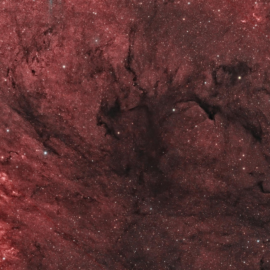
The standard textbooks indicate that the start or conception of a new star formation is the collapse of a molecular cloud.  But my background in thermodynamics, heat/mass transfer and fluid mechanics leaves this superficial explanation ungratifying (at least to me?).  This pervasive theory has already be debunked in my description of spiral galactic structure, but what should replace it?  What would cause a molecular cloud or part of one to “collapse”.  I have presented here, three variations of the same view of the Bernard 169 (the loopy one on the right), and Bernard 174 (shaped like a foot on the far left) – both molecular clouds in the process of “collapsing”, or as I would rather put it – condensing – towards star conception.  Both B169 and 174 are dark nebulae that emit no light of their own, but rather block light from the background and reflect any starlight from stars in their proximity.  There are indications, even in this dark nebula, of new star formation – can you spot them?

Circulation and Jewelry – The Galactic Spiral Structure (Part 5)

Circulation and Jewelry – The Galactic Spiral Structure (Part 5)

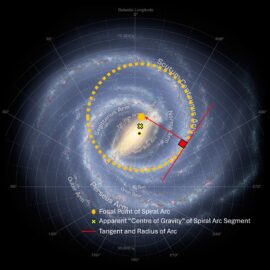
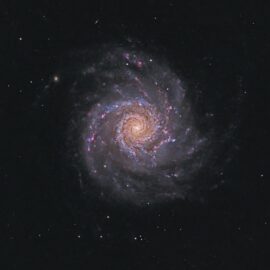
In the ultimate post of the series, we finally get to add some of the things that we image in galaxies – emissions, dust, and stars, to the stuff we can’t see – hydrogen and black holes. The stuff we can see brings life to the galaxy and are indeed necessarily for its longevity and new star production.
Gravity is shown to be periodic both in radial and angular directions, just like the spiral, but the various forces at play effect the galactic jewelry in different ways to give us regions of emissions, dust lanes, and star orbits. Explanations are provides as to why the arms can extend for radii way beyond what we do see, why dark matter is unnecessary (just a hydrogen accounting error). The spiral structure even explains why velocity vs radius plots look periodic when even dark matter doesn’t explain it.

The Rotten Fish Heat Engine – LDN1251 (Cepheus) in LRGB

The Rotten Fish Heat Engine – LDN1251 (Cepheus) in LRGB

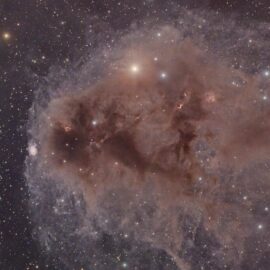
The Rotten Fish Nebula shows a piece of molecular cloud that has been torn from a spiral arm and eroded by ISM wind and turbulence. While we can’t see molecular hydrogen, we can see the light blocking and reflecting dust it carries with it.
Dust plays an important role in keeping the galaxy cool, particularly is dust nodules, such as this. Cold shrinks the gases, keeps the molecular clouds viscous, and provides the very cold temperatures necessary for star formation. It is the galaxies cooling system. A simple, home experiment is suggested that can help bring the role of cloud collapse and even star nucleation to real life.

Winding Problem Solved – Galactic Spiral Structure (Part 4)

Winding Problem Solved – Galactic Spiral Structure (Part 4)

If the galaxy were a disk, gravity would act toward the centre of the galaxy, centrifugal forces in the opposite direction, and viscous drag perpendicular to both. In a galactic spiral structure, this is not the case as components of all three forces act along and perpendicular to the spiral arms. This gives spiral shapes the ability to avoid the arms winding upon each other, and even orbits spots that aren’t at the galactic centre. Force balances on the spiral arms, show how this comes together in this detailed analysis. The post is long, but I think insightful and revealing. Coupled with the thermodynamics of hydrogen – even does away for the need for dark matter.

From Torus to Spiral Disk – Galactic Spiral Structure (Part 3)

From Torus to Spiral Disk – Galactic Spiral Structure (Part 3)

Introducing viscous drag and fluid mechanics into what shapes a spiral galaxy. Astrophysicists avoid fluid mechanics like the plague, but understanding this energy disapative force is the only way to understand how spirals work. Shortcuts only lead to weird and fantastic stories, many of which are accepted in popular descriptions. Spiral flow patterns are common here on earth (some, like hurricanes are too common) and so this topic deserves an earthly description.

Narrowband Light & Filters – A Quick Overview

Narrowband Light & Filters – A Quick Overview

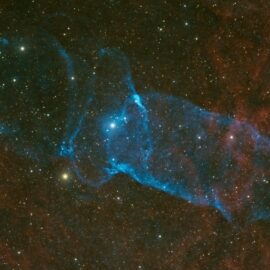
Using the fascinating and recently discovered Squid Nebula (Ou4) as an example, I discuss the use of narrowband filters to image emission nebula. To emit light at specific narrowbands, the right element, degree of stimulation (UV light), and even density must be present. It makes for beautiful images and reveals a lot of structure in the targets.

Torus of Gravity vs Momentum – Galactic Spiral Structure (Part 2)

Torus of Gravity vs Momentum – Galactic Spiral Structure (Part 2)

In this second posting in the series, angular momentum is added as a second force guiding the structure of spiral galaxies. The coupling of angular momentum with gravity leads to the generalization of the overall shape of a galaxy as a torus, or toroidal disc. The gravitational force associated with a toroidal disk is explored and it is far more complex than a spherical shell.