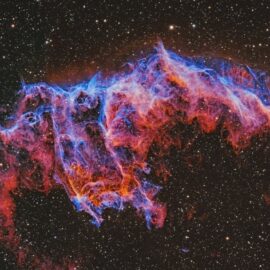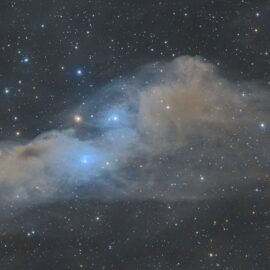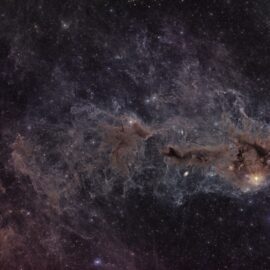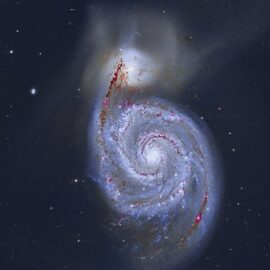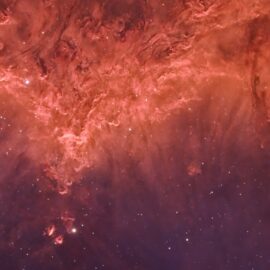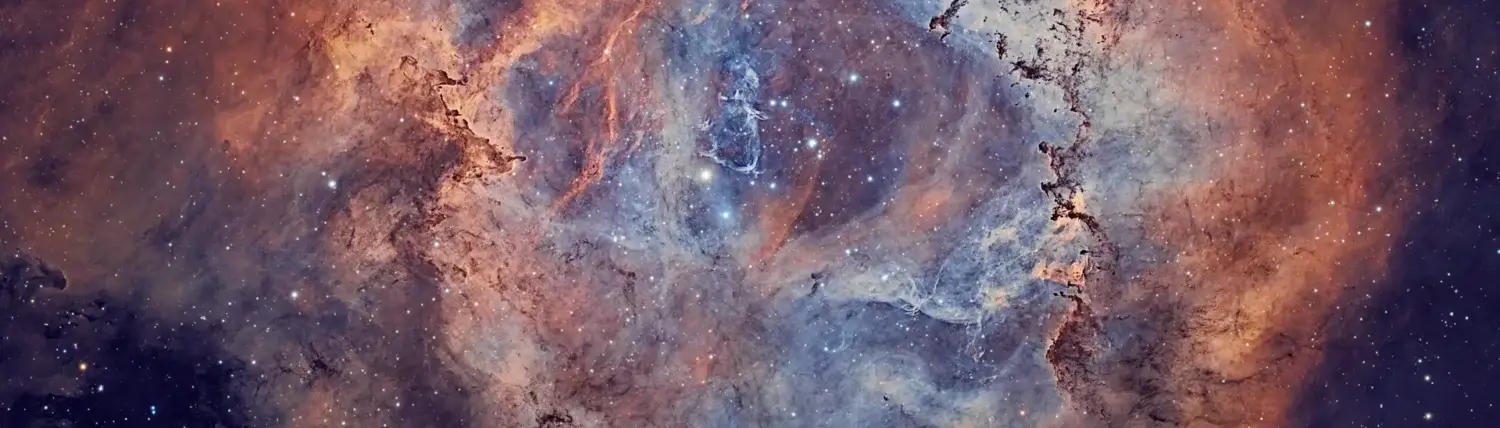

There is no deny that the dark nebula, LDN 534, makes an interesting target for astrophotography. It has all the earmarks of sky clouds being transformed by the wind. In fact it is likely a section of molecular cloud ripped out of the spiral arms, and being eroded by the winds of ISM. Unlike star fields that appear like foggy light that gets more disperse as concentration drops, the eroded molecular cloud seems to be much more wispy and reluctant to yield its integrity. Undoubtedly the hydrogen molecules do yield to the wind, disassociating to become atoms while the dust gets dispersed. We are lucky in this one, as a few stars make some nice blue reflections. In other cases, the eroded molecular cloud forms very coincidental shapes – included some naturally streamlined ones.
A Rotting Fish tells no tails

In this website’s second look at the Rotten Fish dark nebula, I wanted to bring home the concenpts involved in star nucleation. In case you were wondering, the answer is yes, star formation can happen in clouds not emitting Halpha light, even though we can certainly assiciate Haspha with star cluster / stellar nurseries. The answer lies in the mechanism of pressure buildup at points allowing diatomic molecular hydrogen and dust to nucleate a star. In both cases, dust provides the necessary cold temperature in addition to critical point temperature suppression. However, in the case of a dark cloud, the pressures required to nucleation is based on cloud turbulence alone, while stellar nursery clouds are aided in pressure build-up by stellar winds. It seems from images, that star formation in clouds is much more sporadic, while star clusters are more likely to be formed in stellar nurseries shining in Halpha light.
The Whirlpool Galaxy (M51) – In for Questioning

The M51 Galaxy or “The Whirlpool Galaxy” definitely strikes an awsome pose, with its two apparent “centres”, and multiple star fuzzies emanating from its extremes. I decided to get all Sherlock Holmesy on it in my desire to figure out what was going on. Yes it is two glalaxies interacting, but what is the nature of this interaction. What happened to its bottom arm? – it looks like it was bitten off. The upper arm looks more intact, but also exhibiting Halpha starburst too. Is the bottom of the galaxy connected to the top with stars circling the left hand side? Can infrared light help us? Can it potentially reveal something? I recommend reading more to find out.
Stars are born – Have a Cigar

In an everyday spiral galaxy (ho hum?), every effort is made by the galaxy itself to minimize the amount of energy wasted on forming turbulence of dust and hydrogen. As a result, areas of intense star formation in a regular spiral is usually restricted to a discrete points along the spiral arms where ISM and molecular cloud rub against each other to create the turbulence. These limited areas of star formation are seen as patches of bright red Halpha emissions. In this image of the Cigar Galaxy, it is evident that something has thrown “a wrench/spanner into the works” and created a hell of lot of turbulence, resulting in a fireworks display of red Halpha. When this occurs, stars are created at a very high rate and we reclassify such galaxies as “starburst” glaxies and the Cigar is one of them. Still, the original stars and dust lanes of this once regular spiral can be made out.
The Cave Nebula and Hydrogen’s Journey

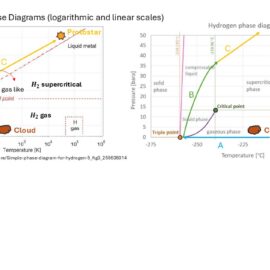
One cannot understand the creation of stars from molecular hydrogen clouds any more than one can understand the weather here on earth without reference to thermodynamics. The weather is largely driven by water in gaseous (vapour), liquid (rain, clouds) and solid (snow, ice and ice crystals) forms. Knowing the pressures and temperatures at which these physical phase states occur is fundamental for both water in its role of creating weather, and for hydrogen in its role of creating both stars and the galaxy itself. Every atom and molecule of hydrogen must undergo and piecewise continuous journey through its phase/space – there is no leaping allowed, and the conditions must exist somewhere in a system for phase transitions to occur.
In our description of galaxies, we discuss the atomic and molecular phase states of hydrogen, but here we illustrate and explain the rest of the phase/state journey that hydrogen, at least at the nucleus of a star, must undergo to enable star formation. This is a journey from molecular gas all the way to becoming a hot, molten, liquid metal.
Swirls, Eddies, and Star Nucleation in Molecular Clouds

The popular notion that stars are created by the spontaneous, adiabatic collapse of molecular clouds is challenged. Instead, a more physically realistic model of protostar nucleation through hydrogen/dust condensation is proposed here (and in other postings) on this website) as well as by many other astronomers and astrophyscists elsewhere. Thermodynamics dictate that such condensation requires relatively cold and places within the cloud enable such condensation coupled with possible dew/sublimation point elevation. The high pressures required is likely provides by turbulence – both viscous and electromagnetic as evidenced by independent simulations. We can also see that for ourselves in our images of molecular clouds.
Wolf Rayet Star – A Giant Star’s Transformation

The Crescent Nebula looks like supernova has gone off, creating the tendrilly patterns of material emitted or gathered up at the front of supersonic shock waves. The Crescent Nebula is not a supernova remnant, but contains a Wolf Rayet star at its heart.. However, unlike a massive star going supernova, only to leave a neutron or black hole behind, a giant Wolf Rayet star is left shining after the explosion(s). The star may even be following up with more either periodically or even continuously. In this short post, I merely speculate because I will have to learn more myself….