
Abell 39: A planetary nebula and the most perfect sphere in the night sky

Abell 39: A planetary nebula and the most perfect sphere in the night sky

Discover the mesmerizing beauty of Abell 39, a planetary nebula renowned for its stunning spherical shape. While many nebulae are complex and chaotic, Abell 39 stands out as a rare gem in the night sky. This article delves into the fascinating evolution of stars, from their fiery beginnings as main sequence stars to their transformation into white dwarfs and the breathtaking nebulae they leave behind. Join us on a journey through the cosmos, exploring the intricate processes that create these celestial wonders and the vital role they play in the universe’s grand tapestry.

The Sunflower Galaxy and Dynamic Complexities

The Sunflower Galaxy and Dynamic Complexities

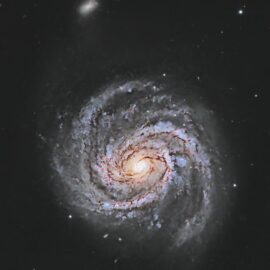
At first glance, Messier 63 (M63 for short or aka “the Sunflower Galaxy”) appears to be a break from the traditional spiral structure of galaxies and represent a new type of galaxy termed a “flocculent” class.  It was thought that the stars formed clumpy clouds gathered together as clumps, like strands of wool form clumps of wool – even on the sheep.    In chemical engineering, we often use agents that make particles suspended in a fluid clump together to form larger particles ,so that gravity can overcome the suspension and separate the particles from the fluid.   I like to thing that the word flocculate (or its sorter “floc”) comes from the word “flock”, as in a flock of sheep,

The Anatomy of a Stellar Nursery

The Anatomy of a Stellar Nursery

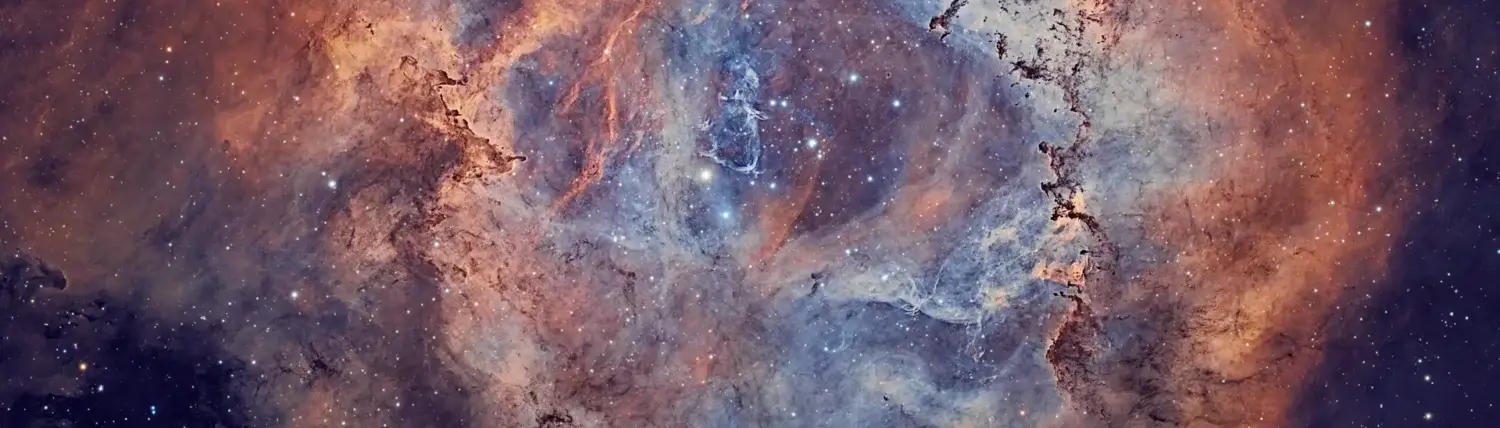
Introducing the Rosette Nebula / Stellar Nursery When I first started to image stellar nurseries, I really didn’t know anything about them.  I was told that stars are being born there – that is pretty awesome, but I was curious what was it about these light generating molecular clouds (MCs) that made them prolific star builders.   Sure, stars are also created in turbulent dark molecular clouds, but stellar nurseries really churn out the stars at a much higher level – often creating whole open clusters of stars.   Many of the stellar nurseries get very large and can even be mapped from their Halpha light signal in other galaxies.   Ok, so my interest was piqued – I had to figure out

Star Nucleation Amped Up by Tidal Effects

Star Nucleation Amped Up by Tidal Effects

Spiral galaxies can vary widely in the amount of stars they are generating. It is asserted that star nucleation, via the imposition of high pressure over small volumes of molecular cloud, is the rate determining step. Turbulence of molecular clouds in galaxies is greatly increased when the chaotic, but stable, spiral galactic structure is disturbed by tidal effects of nearby galaxies. In this posting, the three main galaxies of the Leo triplet are used to illustrate and link the chain of events from tidal influence to rapid star production in the galaxies we image.

Fueling up a New Star – Gravity vs Angular Momentum

Fueling up a New Star – Gravity vs Angular Momentum

In order to grow, a nucleated (condensed), cold star core must accumulate hydrogen as future mass and fuel before igniting to fusion and becoming a full fledged shining star. But there is a problem in the way. Just as the sun cannot accumulate planets via gravity, without some mechanism to shed angular momentum, hydrogen will just orbit the baby star and not accumulate upon it. Viscous drag both dissipates angular momentum and allows hydrogen molecules to accumulate by spiraling down to the star. Unlike a planetary orbit, in a spiral gravity, angular momentum, and viscous drag (friction) are not orthogonal to one another, allowing friction to dissipate momentum as the gravitational fall increases it. Upon arrival at the star, there remains a lot of angular momentum that still need dissipating. Compressed, hot hydrogen forms a metallic core on the star where it creates an electromagnetic magneto – a sort of electric motor. The magneto converts angular momentum into linear momentum that squirts out as jets from the poles. Both mechanisms allow hydrogen to accumulate without spinning the young protostar to death. The jets also advertise to us that star formation is going on and results in beautiful images.

The Hidden Galaxy – Now you see it

The Hidden Galaxy – Now you see it

IC342/Caldwell 5 – The Hidden Galaxy in LHaRGB Planewave CDK 12.5in; AP 1100GTO AE; QHY600M, – Baader Cmos Opt Broadband and 6.5nm Ha FiltersL: (50 x 180s, Bin 1, Gain 100); H: (29 x 720s Bin 1, Gain 100); R,G,B: (25,23,22 x 210s, Bin 1, Gain 100)Total integration time = 12.4 hrs (Feb 10-12, 2025) Maple Bay, BC, Canada For full resolution, downloadable image, visit my gallery at Victoria RASC Zenfolio or Astobin The Hidden Galaxy gets its name from its position in the sky, near the Milky Way and partly obscured by our galaxy’s dust.   If not for the dust, IC342 would be visible with the naked eye and occupy about the same size as the moon. In reality