
The Cave Nebula and Hydrogen’s Journey

The Cave Nebula and Hydrogen’s Journey

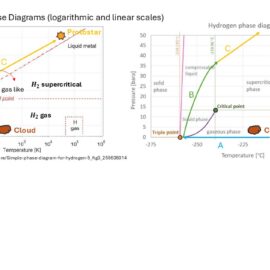
One cannot understand the creation of stars from molecular hydrogen clouds any more than one can understand the weather here on earth without reference to thermodynamics. The weather is largely driven by water in gaseous (vapour), liquid (rain, clouds) and solid (snow, ice and ice crystals) forms. Knowing the pressures and temperatures at which these physical phase states occur is fundamental for both water in its role of creating weather, and for hydrogen in its role of creating both stars and the galaxy itself. Every atom and molecule of hydrogen must undergo and piecewise continuous journey through its phase/space – there is no leaping allowed, and the conditions must exist somewhere in a system for phase transitions to occur.
In our description of galaxies, we discuss the atomic and molecular phase states of hydrogen, but here we illustrate and explain the rest of the phase/state journey that hydrogen, at least at the nucleus of a star, must undergo to enable star formation. This is a journey from molecular gas all the way to becoming a hot, molten, liquid metal.

Collapse of a Molecular Cloud in 3 waves

Collapse of a Molecular Cloud in 3 waves

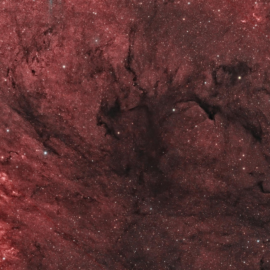
The standard textbooks indicate that the start or conception of a new star formation is the collapse of a molecular cloud.  But my background in thermodynamics, heat/mass transfer and fluid mechanics leaves this superficial explanation ungratifying (at least to me?).  This pervasive theory has already be debunked in my description of spiral galactic structure, but what should replace it?  What would cause a molecular cloud or part of one to “collapse”.  I have presented here, three variations of the same view of the Bernard 169 (the loopy one on the right), and Bernard 174 (shaped like a foot on the far left) – both molecular clouds in the process of “collapsing”, or as I would rather put it – condensing – towards star conception.  Both B169 and 174 are dark nebulae that emit no light of their own, but rather block light from the background and reflect any starlight from stars in their proximity.  There are indications, even in this dark nebula, of new star formation – can you spot them?

Winding Problem Solved – Galactic Spiral Structure (Part 4)

Winding Problem Solved – Galactic Spiral Structure (Part 4)

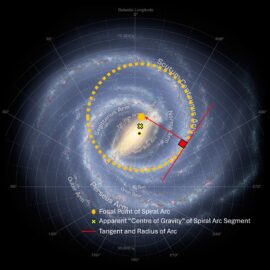
If the galaxy were a disk, gravity would act toward the centre of the galaxy, centrifugal forces in the opposite direction, and viscous drag perpendicular to both. In a galactic spiral structure, this is not the case as components of all three forces act along and perpendicular to the spiral arms. This gives spiral shapes the ability to avoid the arms winding upon each other, and even orbits spots that aren’t at the galactic centre. Force balances on the spiral arms, show how this comes together in this detailed analysis. The post is long, but I think insightful and revealing. Coupled with the thermodynamics of hydrogen – even does away for the need for dark matter.

Narrowband Light & Filters – A Quick Overview

Narrowband Light & Filters – A Quick Overview

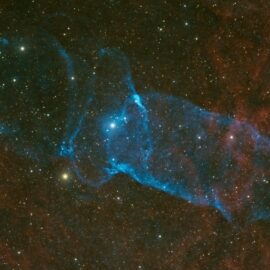
Using the fascinating and recently discovered Squid Nebula (Ou4) as an example, I discuss the use of narrowband filters to image emission nebula. To emit light at specific narrowbands, the right element, degree of stimulation (UV light), and even density must be present. It makes for beautiful images and reveals a lot of structure in the targets.