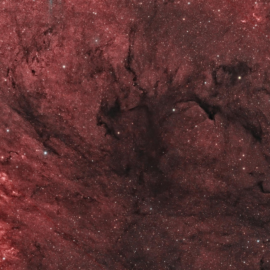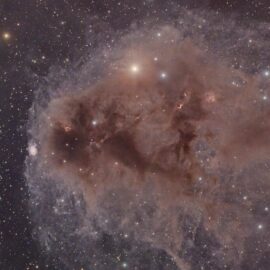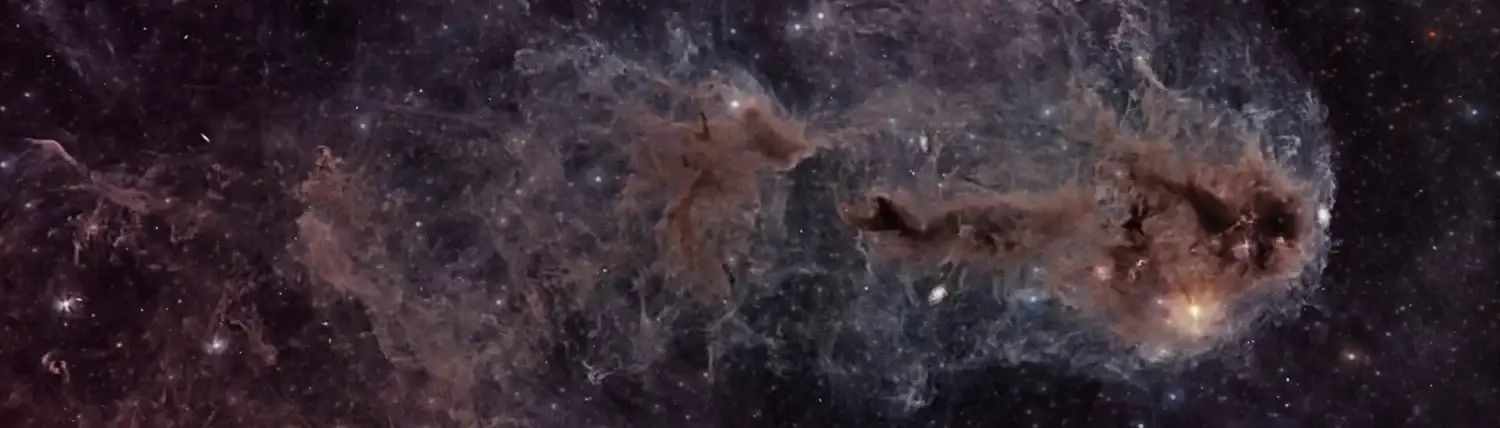

The standard textbooks indicate that the start or conception of a new star formation is the collapse of a molecular cloud. But my background in thermodynamics, heat/mass transfer and fluid mechanics leaves this superficial explanation ungratifying (at least to me?). This pervasive theory has already be debunked in my description of spiral galactic structure, but what should replace it? What would cause a molecular cloud or part of one to “collapse”. I have presented here, three variations of the same view of the Bernard 169 (the loopy one on the right), and Bernard 174 (shaped like a foot on the far left) – both molecular clouds in the process of “collapsing”, or as I would rather put it – condensing – towards star conception. Both B169 and 174 are dark nebulae that emit no light of their own, but rather block light from the background and reflect any starlight from stars in their proximity. There are indications, even in this dark nebula, of new star formation – can you spot them?
Collapse of a Molecular Cloud in 3 waves