A Rotting Fish tells no tails

A Rotting Fish tells no tails

In this website’s second look at the Rotten Fish dark nebula, I wanted to bring home the concenpts involved in star nucleation. In case you were wondering, the answer is yes, star formation can happen in clouds not emitting Halpha light, even though we can certainly assiciate Haspha with star cluster / stellar nurseries. The answer lies in the mechanism of pressure buildup at points allowing diatomic molecular hydrogen and dust to nucleate a star. In both cases, dust provides the necessary cold temperature in addition to critical point temperature suppression. However, in the case of a dark cloud, the pressures required to nucleation is based on cloud turbulence alone, while stellar nursery clouds are aided in pressure build-up by stellar winds. It seems from images, that star formation in clouds is much more sporadic, while star clusters are more likely to be formed in stellar nurseries shining in Halpha light.

Stars are born – Have a Cigar

Stars are born – Have a Cigar

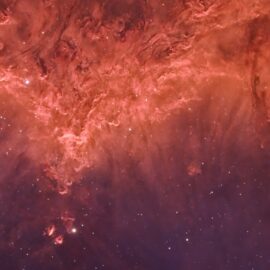
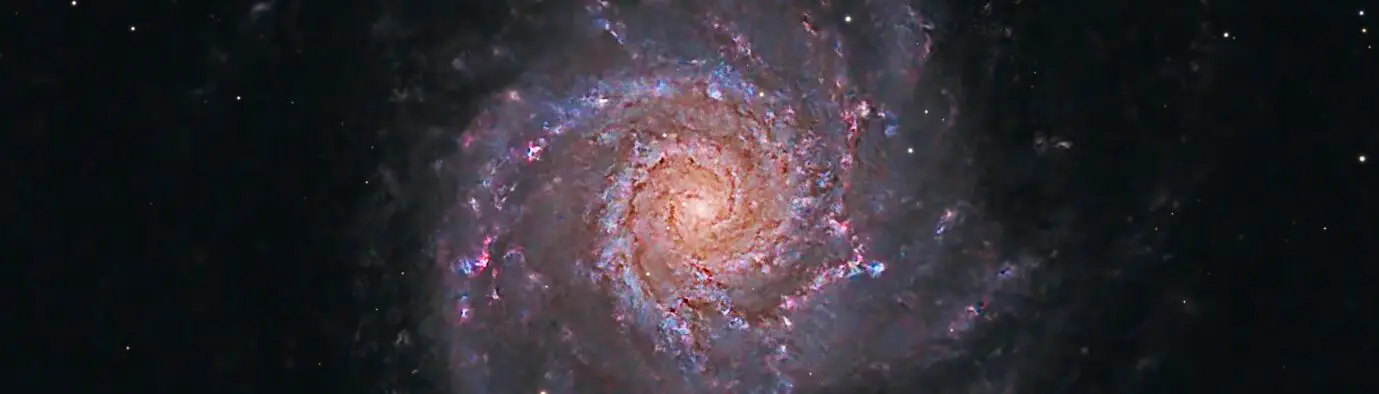
In an everyday spiral galaxy (ho hum?), every effort is made by the galaxy itself to minimize the amount of energy wasted on forming turbulence of dust and hydrogen. As a result, areas of intense star formation in a regular spiral is usually restricted to a discrete points along the spiral arms where ISM and molecular cloud rub against each other to create the turbulence. These limited areas of star formation are seen as patches of bright red Halpha emissions. In this image of the Cigar Galaxy, it is evident that something has thrown “a wrench/spanner into the works” and created a hell of lot of turbulence, resulting in a fireworks display of red Halpha. When this occurs, stars are created at a very high rate and we reclassify such galaxies as “starburst” glaxies and the Cigar is one of them. Still, the original stars and dust lanes of this once regular spiral can be made out.

The Cave Nebula and Hydrogen’s Journey

The Cave Nebula and Hydrogen’s Journey

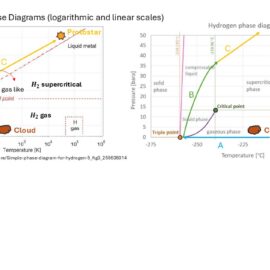
One cannot understand the creation of stars from molecular hydrogen clouds any more than one can understand the weather here on earth without reference to thermodynamics. The weather is largely driven by water in gaseous (vapour), liquid (rain, clouds) and solid (snow, ice and ice crystals) forms. Knowing the pressures and temperatures at which these physical phase states occur is fundamental for both water in its role of creating weather, and for hydrogen in its role of creating both stars and the galaxy itself. Every atom and molecule of hydrogen must undergo and piecewise continuous journey through its phase/space – there is no leaping allowed, and the conditions must exist somewhere in a system for phase transitions to occur.
In our description of galaxies, we discuss the atomic and molecular phase states of hydrogen, but here we illustrate and explain the rest of the phase/state journey that hydrogen, at least at the nucleus of a star, must undergo to enable star formation. This is a journey from molecular gas all the way to becoming a hot, molten, liquid metal.

Swirls, Eddies, and Star Nucleation in Molecular Clouds

Swirls, Eddies, and Star Nucleation in Molecular Clouds

The popular notion that stars are created by the spontaneous, adiabatic collapse of molecular clouds is challenged. Instead, a more physically realistic model of protostar nucleation through hydrogen/dust condensation is proposed here (and in other postings) on this website) as well as by many other astronomers and astrophyscists elsewhere. Thermodynamics dictate that such condensation requires relatively cold and places within the cloud enable such condensation coupled with possible dew/sublimation point elevation. The high pressures required is likely provides by turbulence – both viscous and electromagnetic as evidenced by independent simulations. We can also see that for ourselves in our images of molecular clouds.

Collapse of a Molecular Cloud in 3 waves

Collapse of a Molecular Cloud in 3 waves

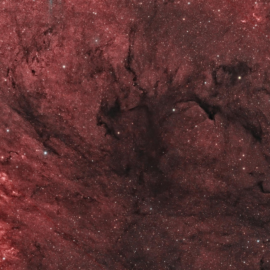
The standard textbooks indicate that the start or conception of a new star formation is the collapse of a molecular cloud.  But my background in thermodynamics, heat/mass transfer and fluid mechanics leaves this superficial explanation ungratifying (at least to me?).  This pervasive theory has already be debunked in my description of spiral galactic structure, but what should replace it?  What would cause a molecular cloud or part of one to “collapse”.  I have presented here, three variations of the same view of the Bernard 169 (the loopy one on the right), and Bernard 174 (shaped like a foot on the far left) – both molecular clouds in the process of “collapsing”, or as I would rather put it – condensing – towards star conception.  Both B169 and 174 are dark nebulae that emit no light of their own, but rather block light from the background and reflect any starlight from stars in their proximity.  There are indications, even in this dark nebula, of new star formation – can you spot them?

Circulation and Jewelry – The Galactic Spiral Structure (Part 5)

Circulation and Jewelry – The Galactic Spiral Structure (Part 5)

In the ultimate post of the series, we finally get to add some of the things that we image in galaxies – emissions, dust, and stars, to the stuff we can’t see – hydrogen and black holes. The stuff we can see brings life to the galaxy and are indeed necessarily for its longevity and new star production.
Gravity is shown to be periodic both in radial and angular directions, just like the spiral, but the various forces at play effect the galactic jewelry in different ways to give us regions of emissions, dust lanes, and star orbits. Explanations are provides as to why the arms can extend for radii way beyond what we do see, why dark matter is unnecessary (just a hydrogen accounting error). The spiral structure even explains why velocity vs radius plots look periodic when even dark matter doesn’t explain it.

The Rotten Fish Heat Engine – LDN1251 (Cepheus) in LRGB

The Rotten Fish Heat Engine – LDN1251 (Cepheus) in LRGB

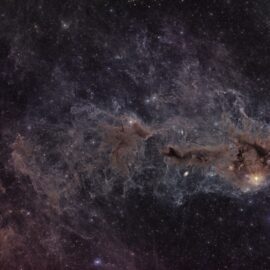
The Rotten Fish Nebula shows a piece of molecular cloud that has been torn from a spiral arm and eroded by ISM wind and turbulence. While we can’t see molecular hydrogen, we can see the light blocking and reflecting dust it carries with it.
Dust plays an important role in keeping the galaxy cool, particularly is dust nodules, such as this. Cold shrinks the gases, keeps the molecular clouds viscous, and provides the very cold temperatures necessary for star formation. It is the galaxies cooling system. A simple, home experiment is suggested that can help bring the role of cloud collapse and even star nucleation to real life.