
Crescent Nebula (NGC6888) in SHO
Askar 151phq; AP Mach2 GTO, ASI6200MM, – Chroma RGB & 5nm Narrowband Filters
H,O,S: (37,24,27 x 720s 61Bin 1, Gain 100) R,G,B: (16,15,12 x 120s, Bin 1, Gain 100)
Total integration time = 19.0 hrs (June 12,13,14,18,20,22 – 2024) (full res RASC Zenfolio or Astrobin)

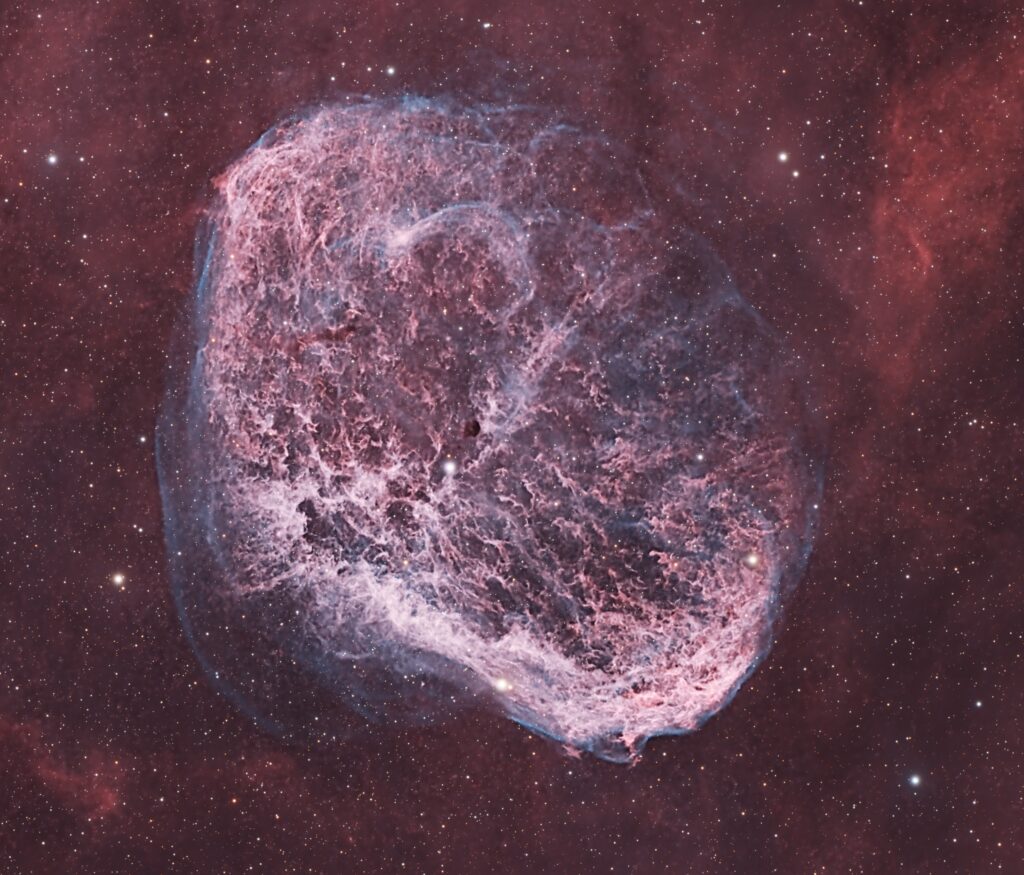
Crescent Nebula (NGC6888) in SHO
Askar 151phq; AP Mach2 GTO; ASI6200MM, – Chroma RGB & 5nm Narrowband Filters
H,O,S: (37,24,27 x 720s 61Bin 1, Gain 100); R,G,B: (16,15,12 x 120s, Bin 1, Gain 100)
Total integration time = 19.0 hrs (June 12,13,14,18,20,22, 2024)
For downloadable, full resolution follow links to Victoria RASC Zenfolio or Astrobin.
The Crescent Nebula is the result of the expansion of material, mainly hydrogen, given off by a star when it transformed into a red giant about 250 to 400 thousand years ago. Subsequent winds from this star continue to propel the material outward creating supersonic shock fronts, and at the same time cause the hydrogen in the shock fronts to light up in red. The red tendril web appearance is the result of shock fronts colliding and interfering. The red hydrogen web is engulfed in a bubbly, blue shell of very low density doubly ionized oxygen. Oxygen likes it electrons very much, and it takes very high energy photons to create this ionization, in this case, likely originating from the progenitor star. Alternatively, emissions can also be generated via the high temperatures reached by the material during supersonic flow.
The structure of the crescent is very characteristic of the remnants when a star implodes in a super-nova, but in this case the star remains as a “Wolf Rayet” star. The difference is that Wolf Rayet expulsions of material are either continuous or periodic, while supernovae are a one time deal as a large star dies. The shape of the nebula is likely a result of asymmetry in stellar winds from the Wolf Rayet and partly a result of variations in density and winds in the material that it is expanding into. It is termed the “Crescent Nebula” because only the brightest part of the Nebula, forming a crescent or a Euro symbol can be seen visually. The crescent can be seen by squinting at the image – and even better if you are older by taking off your reading glasses ;-).
The molecular cloud in the background? is also interesting. Being lit up gently by the dense star field or its own temperature (again, I am not sure which), it shows the characteristics of turbulent viscous flow. Being a devout propellor head, I just find fluid mechanics so interesting, and there is such a limited understanding of the properties and state of the predominantly hydrogen within these clouds. One of the goals of this website is to puzzle this out.
This image represented first light for my new Chroma filters.


